
Knowing what to study for NCLEX is the first and most important question every nursing graduate faces when they begin exam preparation — and it is also one of the most overwhelming. The NCLEX covers an enormous range of nursing content, and without a clear starting point and a sense of priority, it is easy to spend weeks studying in the wrong direction.
The good news is that the NCLEX does not test everything equally. The exam is built around a defined test plan published by the NCSBN that specifies exactly which content categories are assessed and how heavily each one is weighted. Once you understand that structure, the question of what to study for NCLEX becomes much more manageable — and much less intimidating.
This beginner’s guide walks you through everything you need to know to start your NCLEX preparation on the right foot in 2026. You will learn how the exam is organized, which content areas to prioritize first, how the Next Generation NCLEX differs from the traditional format, and how to build a study approach that is both efficient and effective from day one.
Understanding the NCLEX Before You Decide What to Study
Before you open a review book or start a practice question, understanding what to study for NCLEX begins with understanding what the exam actually measures. The NCLEX is not a knowledge recall test. It is a clinical judgment assessment designed to determine whether you can think and act like a safe, entry-level registered nurse.
This distinction matters enormously for how you prepare. Students who approach the NCLEX as a memorization exercise — trying to learn every disease process, every drug, every lab value — typically find themselves overwhelmed and underprepared. Students who understand that the exam is testing clinical reasoning — the ability to assess a patient, identify priorities, make sound decisions, and evaluate outcomes — are able to focus their preparation far more effectively.
The Next Generation NCLEX, which launched in April 2023, reinforces this by testing clinical judgment explicitly through new question formats including unfolding case studies, bow tie questions, and extended multiple response items. These formats ask you to apply nursing knowledge to evolving patient scenarios, not recite it in isolation. Knowing this shapes your entire answer to the question of what to study for NCLEX — it is not just content, it is content plus reasoning.
The NCSBN Test Plan: Your Most Important Starting Resource
The NCSBN publishes a detailed test plan for the NCLEX that outlines every content category assessed on the exam, the percentage weight of each category, and the cognitive skills being measured. This document is free, available on the NCSBN website, and is the single most authoritative resource for understanding what to study for NCLEX. Before you invest in a review course or pick up a prep book, download the current test plan and read it. It will give you a clear map of the terrain before you start the journey.
What to Study for NCLEX First: The Highest-Priority Content Areas
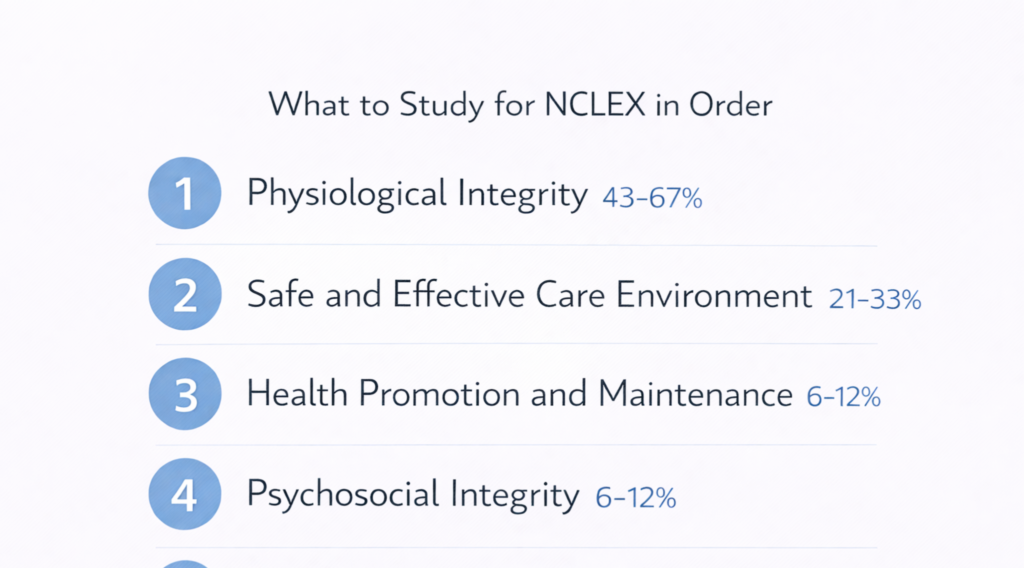
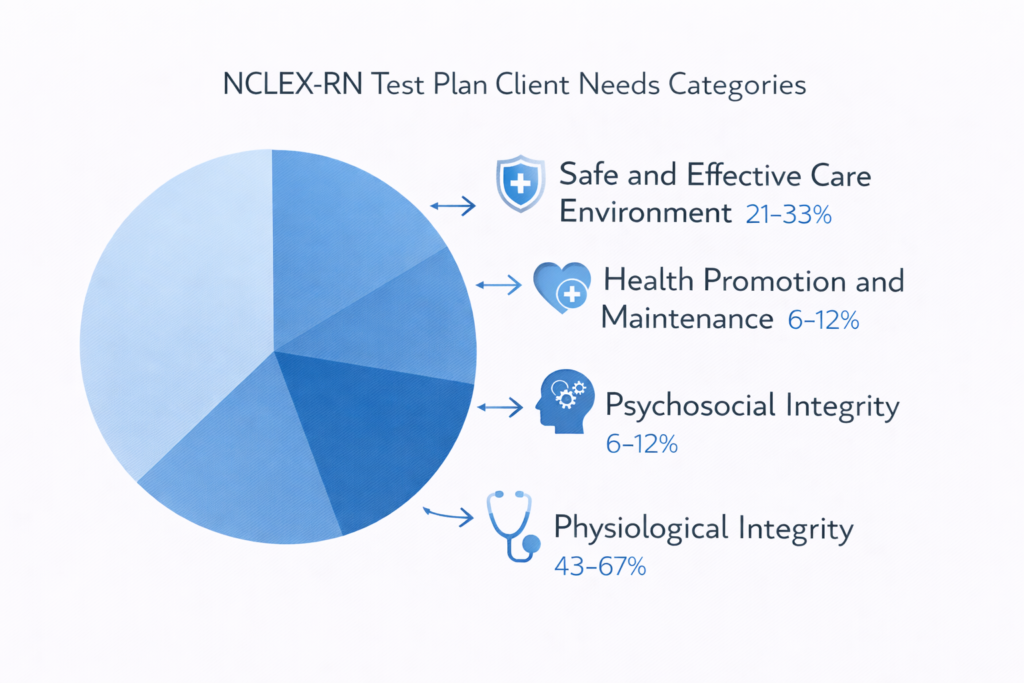
When deciding what to study for NCLEX, start with the content categories that carry the heaviest weight on the exam. The NCSBN test plan divides the NCLEX-RN into four major client needs categories, and understanding how much each one contributes to your total score is the foundation of smart prioritization.
Physiological Integrity: The Largest Category
Physiological integrity is the largest client needs category on the NCLEX-RN, comprising four subcategories that together make up approximately 38 to 62 percent of the exam. This is the first place to focus when determining what to study for NCLEX. The four subcategories are basic care and comfort, pharmacological and parenteral therapies, reduction of risk potential, and physiological adaptation. Within these subcategories, the highest-yield content areas are cardiovascular nursing, respiratory nursing, neurological nursing, fluid and electrolyte management, endocrine disorders, renal nursing, and pharmacology. These are the topics that appear most frequently, carry the most questions, and should anchor the first weeks of your preparation.
Safe and Effective Care Environment
The safe and effective care environment category is the second major priority when mapping out what to study for NCLEX. It accounts for approximately 15 to 21 percent of the exam across its two subcategories: management of care and safety and infection control. Management of care questions test your knowledge of delegation, prioritization, client rights, legal and ethical nursing practice, and the nurse’s role within the healthcare team. Safety and infection control questions cover standard and transmission-based precautions, fall prevention, safe medication administration, and emergency response. These topics are tested constantly throughout the exam and often serve as the decision-making framework for questions drawn from other content areas.
Health Promotion and Maintenance
Health promotion and maintenance accounts for approximately 6 to 12 percent of the NCLEX-RN and covers developmental stages across the lifespan, health screenings, immunizations, antepartum and postpartum care, newborn assessment, and patient education. For a beginner building a plan for what to study for NCLEX, this category includes maternal newborn nursing, pediatric nursing, growth and development milestones, and the nurse’s role in teaching patients about disease prevention and health management.
Psychosocial Integrity
Psychosocial integrity accounts for approximately 6 to 12 percent of the exam and covers mental health nursing, therapeutic communication, crisis intervention, coping and adaptation, and substance use disorders. While it carries a smaller percentage than physiological integrity, psychosocial questions require a fundamentally different reasoning approach — one centered on communication, patient rights, and psychological safety — and should not be left as an afterthought in your preparation.
The Most Important High-Yield Topics Within Each NCLEX Content Area
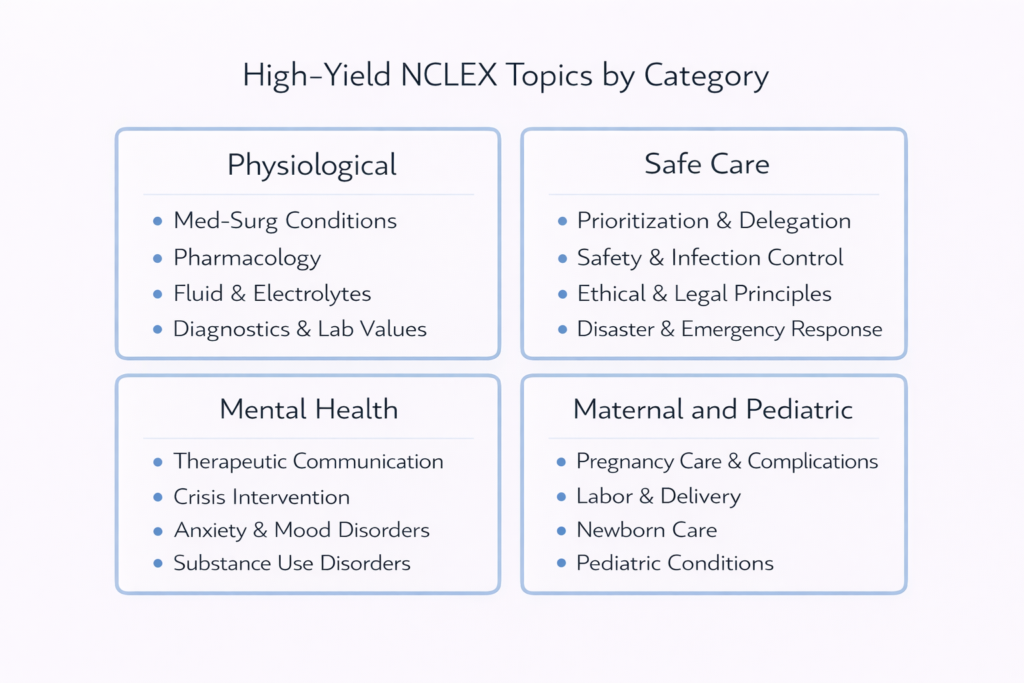
Within each major category, certain topics are tested far more frequently than others. Knowing these high-yield clusters is essential for any beginner figuring out what to study for NCLEX efficiently.
High-Yield Physiological Topics
Within physiological integrity, the topics that appear most consistently are heart failure and cardiac medications, cardiac dysrhythmias, stroke and increased intracranial pressure, respiratory failure and oxygenation, diabetic emergencies including DKA and hypoglycemia, acute kidney injury and fluid and electrolyte imbalances, and postoperative nursing care. Pharmacology is embedded throughout all of these — the highest-yield drug classes are anticoagulants, antihypertensives, diuretics, insulin, opioids, antibiotics, and antiseizure medications.
High-Yield Safe Care Topics
Within safe and effective care environment, the topics tested most heavily are the five rights of delegation and which tasks can and cannot be assigned to LPNs or unlicensed assistive personnel, the chain of command and when to escalate, standard and contact and airborne and droplet precautions, medication administration safety including the rights of medication administration, and legal and ethical principles including informed consent, advance directives, and mandatory reporting.
High-Yield Mental Health Topics
Within psychosocial integrity, the highest-yield topics are therapeutic communication and the responses that are consistently therapeutic versus non-therapeutic, suicide risk assessment and the nurse’s role in creating a safe environment, schizophrenia and antipsychotic medication side effects, mood disorders and lithium therapy, and legal concepts in psychiatric care including voluntary and involuntary admission and the duty to warn.
High-Yield Maternal and Pediatric Topics
Within health promotion and maintenance, the most heavily tested topics are preeclampsia and magnesium sulfate therapy, fetal heart rate interpretation with a focus on late deceleration interventions, postpartum hemorrhage, APGAR scoring, newborn hyperbilirubinemia, growth and development milestones by age group, Erikson’s psychosocial stages and their nursing implications, and the pediatric immunization schedule including live vaccine contraindications.
What to Study for NCLEX: Understanding the Next Generation Format
Any beginner’s guide to what to study for NCLEX in 2026 must address the Next Generation NCLEX. The NGN introduced new question formats that assess clinical judgment directly, and understanding these formats before you begin your preparation will shape how you study from day one.
The Six Cognitive Skills You Must Develop
The NGN is built around the NCSBN’s Clinical Judgment Measurement Model, which defines six cognitive skills: Recognize Cues, Analyze Cues, Prioritize Hypotheses, Generate Solutions, Take Actions, and Evaluate Outcomes. These are not just question categories — they are the reasoning steps a nurse takes with every patient encounter. Building these skills into your daily study practice, not just memorizing content, is what the NGN demands. When you study a condition, practice moving through all six steps: what would you notice, what does it mean, what is the priority, what would you do, and how would you know if it worked?
New Question Formats to Prepare For
Beyond traditional multiple-choice, the NGN includes unfolding case studies — six-question scenarios that follow an evolving patient — bow tie questions that connect conditions, actions, and outcomes in a visual format, extended multiple response questions, matrix items, and enhanced hot spot questions. When planning what to study for NCLEX, build familiarity with each of these formats into your preparation. The NCSBN provides free sample NGN questions on their website that are the most authentic practice resource available.
How to Build Your Study Plan Around What to Study for NCLEX
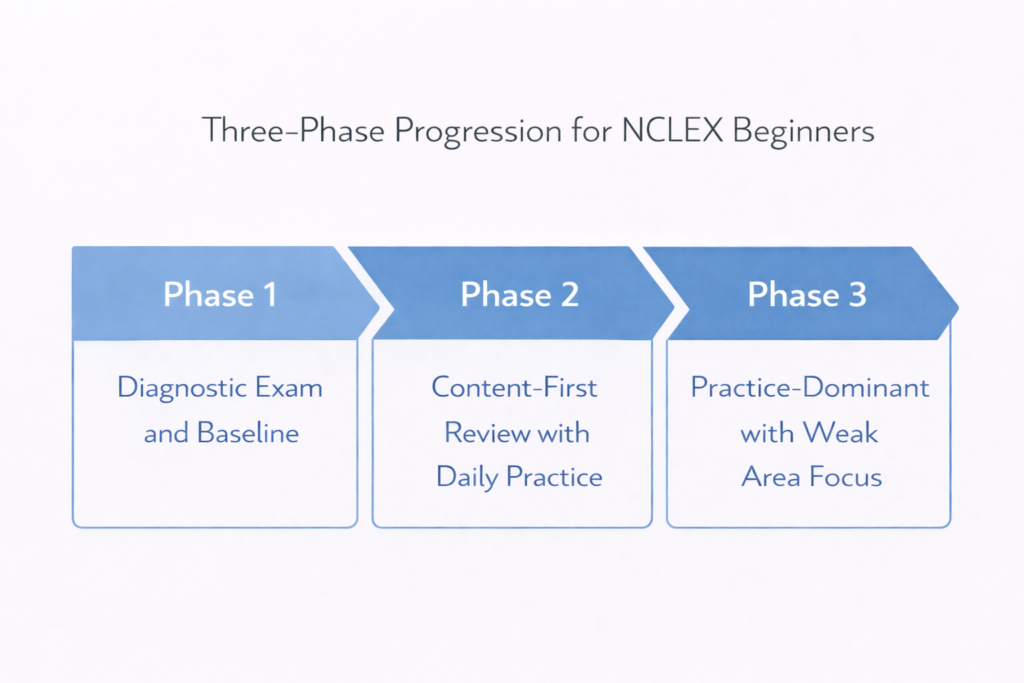
Understanding what to study for NCLEX is only half the equation. The other half is building a realistic, structured plan that covers the right content in the right order with the right methods.
Start with a Diagnostic Practice Exam
Before you assign a single study topic to a single day, take a full diagnostic practice exam of at least 75 questions under timed conditions without any preparation beforehand. Review the performance breakdown by content category. This gives you a personalized picture of what to study for NCLEX based on your actual starting strengths and weaknesses — not a generic guess. The categories where you performed weakest get the most study time in your plan, and the categories where you performed strongly get maintenance review rather than deep study.
Follow a Content-First, Practice-Second Progression
In the first one to two weeks of preparation, prioritize content review over practice questions. Study each high-yield topic deeply, build concept maps, practice active recall, and use 20 to 30 targeted practice questions at the end of each session to test comprehension. From week two onward, gradually shift the balance so that practice questions and rationale review occupy a larger proportion of your daily study time. By the final week of preparation, practice and review should dominate completely.
Use the NCSBN Test Plan as Your Content Checklist
As you move through your preparation, use the NCSBN test plan as a content checklist. Each time you complete a topic cluster, check it against the test plan to confirm you have covered the relevant content area. This prevents the common beginner mistake of studying content that feels important based on nursing school experience but does not actually align with what the NCLEX tests.
Common Mistakes Beginners Make When Deciding What to Study for NCLEX
Understanding what to study for NCLEX is as much about avoiding the wrong approaches as it is about following the right ones. These are the most common mistakes first-time NCLEX candidates make at the start of their preparation.
- Trying to study everything equally: The NCLEX does not test all content equally. Spending equal time on a low-yield topic and a high-yield topic is a costly mistake. Use the NCSBN test plan percentages to guide your time allocation.
- Starting with their weakest content out of anxiety: Many beginners feel compelled to start with the content they fear most. While weak areas need attention, starting your preparation with your most difficult content before you have any momentum often leads to early burnout. Begin with high-yield content you can build confidence on, then work toward your weakest areas.
- Relying entirely on content review without practice questions: Content review alone will not prepare you for the NCLEX’s clinical judgment demands. Practice questions — done under timed conditions with thorough rationale review — are an essential and non-negotiable part of preparation from the very first week.
- Ignoring pharmacology until the end: Pharmacology is tested throughout every content category on the NCLEX. Students who defer pharmacology study until late in their preparation consistently find it the most stressful last-minute rush. Integrate pharmacology review into every content area from day one.
- Skipping the NGN question formats: Many beginners prepare exclusively with traditional multiple-choice questions and encounter the new NGN formats for the first time on exam day. Familiarize yourself with unfolding case studies, bow tie questions, and other NGN formats early — not in the final week.

Conclusion
Knowing what to study for NCLEX before you begin is one of the most valuable advantages you can give yourself as a first-time candidate. The NCLEX has a defined structure, a published test plan, and a clear set of high-yield content areas — and students who align their preparation with that structure consistently outperform those who study without direction. Start with the NCSBN test plan, prioritize physiological integrity and safe care environment content first, integrate pharmacology from day one, build familiarity with NGN question formats early, and take a diagnostic exam to personalize your study order. What to study for NCLEX is not a mystery — it is a map that is available to every candidate who takes the time to read it. Use it, follow it, and trust the preparation you build around it.
What should I study first for the NCLEX?
Start with physiological integrity, which is the largest NCLEX category at approximately 38 to 62 percent of the exam. Within that category, prioritize cardiovascular nursing, respiratory nursing, neurological nursing, fluid and electrolyte management, and pharmacology. These high-yield areas give you the strongest foundation for the rest of your preparation.
How do I know what to study for NCLEX if I have never taken it before?
Download the free NCSBN NCLEX-RN test plan from the NCSBN website. This document outlines every content category and its percentage weight on the exam. Take a diagnostic practice exam to identify your personal weak areas. Together, these two resources give you everything you need to build a personalized, prioritized study plan.
How long should I study for the NCLEX as a first-time candidate?
Most first-time candidates benefit from four to six weeks of structured full-time preparation. The key is consistency, daily practice question review, and a clear content priority order. Quality of preparation matters far more than total hours — four focused weeks outperforms six scattered ones.
Is pharmacology important for the NCLEX?
Yes, significantly. Pharmacology is embedded across every content category on the NCLEX and is one of the most heavily tested areas. Do not defer it to the end of your preparation. Study medication classes — not individual drugs — from day one, focusing on mechanism of action, key side effects, nursing assessments, and patient teaching for the highest-yield classes.
Do I need to study the new NGN question formats for the NCLEX?
Yes. The Next Generation NCLEX includes unfolding case studies, bow tie questions, extended multiple response items, and other new formats that test clinical judgment directly. Familiarizing yourself with these formats early in your preparation — using the free sample questions available on the NCSBN website — is an essential part of knowing what to study for NCLEX in 2026.
Leave a Reply