
NCLEX tutoring is one of the most effective but least understood preparation options available to nursing students. While review books, question banks, and practice apps are the most commonly discussed preparation resources, tutoring offers something that no self-directed tool can replicate: personalized, real-time diagnosis of exactly where your clinical reasoning is breaking down and precisely targeted intervention to correct it. For candidates who have studied extensively and are still not passing — or who are approaching the exam for the first time and want the highest possible probability of success — NCLEX tutoring is often the most efficient path to a passing score.
The misunderstanding most candidates have about NCLEX tutoring is that it is simply more of the same preparation they are already doing, delivered by a person instead of a book or app. Effective NCLEX tutoring is fundamentally different from self-directed study. A skilled tutor does not just review content with you — they watch how you reason through questions, identify the specific point in your clinical reasoning process where errors originate, and redesign your preparation approach to address those specific errors at their root cause. That diagnostic precision is impossible to replicate with any self-directed resource, no matter how high-quality. This guide explains how NCLEX tutoring works, what makes it effective, who benefits most from it, what to look for in a tutor, how to prepare to get maximum value from every tutoring session, and how to integrate tutoring into a complete preparation system. Whether you are a first-time candidate seeking the most focused preparation available or a repeat test-taker who needs a fundamentally different approach after one or more unsuccessful attempts, this guide will help you understand what NCLEX tutoring can realistically do for your preparation and your score.
What NCLEX Tutoring Actually Is and How It Works
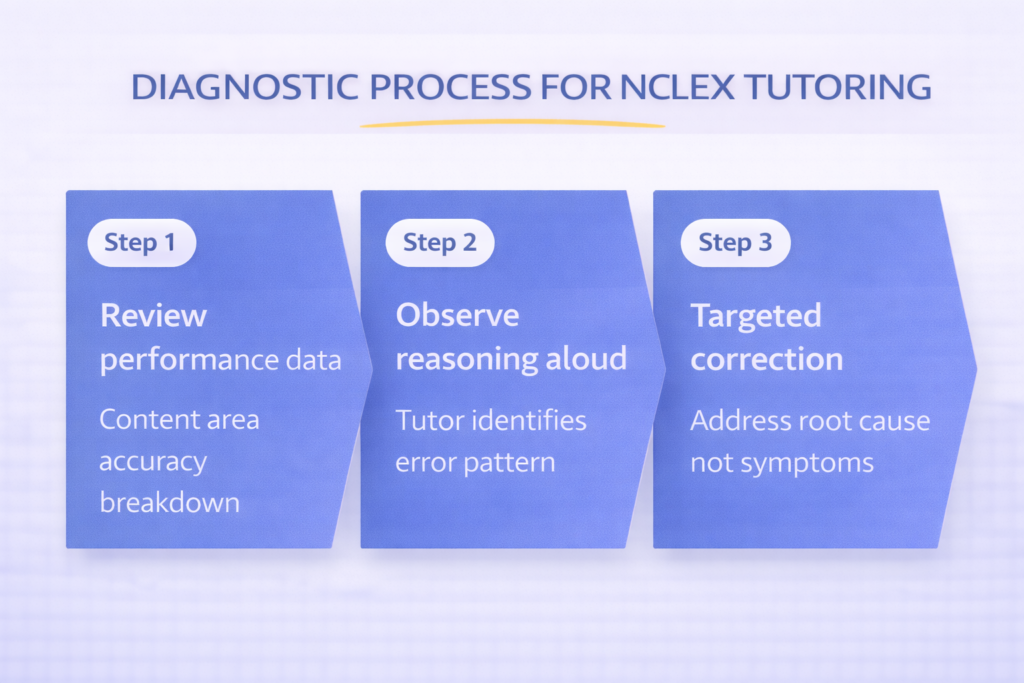
NCLEX tutoring is a personalized, one-on-one instructional relationship between a nursing student and a qualified tutor — typically a registered nurse, nurse educator, or NCLEX preparation specialist — focused specifically on building the clinical reasoning competency the NCLEX measures. Sessions can be conducted in person or, increasingly, via video call, which makes qualified tutors accessible regardless of geographic location. Session frequency and duration vary depending on the candidate’s preparation timeline and budget, ranging from intensive daily sessions in the weeks before a scheduled exam to weekly sessions spread across a longer preparation period.
What distinguishes effective NCLEX tutoring from other preparation formats is the diagnostic loop that drives every session. Before a tutoring relationship can produce targeted improvement, the tutor must identify exactly where the candidate’s reasoning is breaking down. This happens through a structured diagnostic process: the tutor reviews the candidate’s practice question performance data, observes the candidate reasoning through questions aloud, asks probing questions about the clinical reasoning behind each answer choice, and identifies the specific error pattern — content gap, reasoning framework misapplication, test-taking habit, or clinical judgment deficit — that is generating the incorrect answers. The session then focuses on correcting that specific error rather than reviewing content broadly.
This diagnostic precision is the core of what makes NCLEX tutoring different from self-directed preparation. When you study independently, you can identify that your cardiovascular accuracy is lower than your overall average — but you cannot easily determine whether that lower accuracy stems from weak pathophysiology knowledge, incorrect application of the ABCs priority framework, a habit of selecting the most dramatic intervention rather than the most clinically appropriate one, or misreading question stems that contain specific cardiovascular keywords. A skilled NCLEX tutor can identify which of these root causes is driving your performance within a single session, and target the correction precisely.
The Most Common Root Causes a Tutor Identifies
Experienced NCLEX tutoring specialists consistently identify the same recurring patterns in candidates who are not yet passing. The most common root causes include applying adult reasoning frameworks to pediatric or maternal scenarios without developmental adjustment, consistently selecting intervention options before completing the assessment step the question requires, reading answer options before fully processing the question stem — which primes selection toward familiar-sounding distractors — misidentifying the priority problem in multi-system scenarios, and applying the correct clinical reasoning framework to the wrong stage of the nursing process. None of these errors are obvious to candidates from their practice scores alone, and all of them are correctable once precisely identified.
Who Benefits Most From NCLEX Tutoring
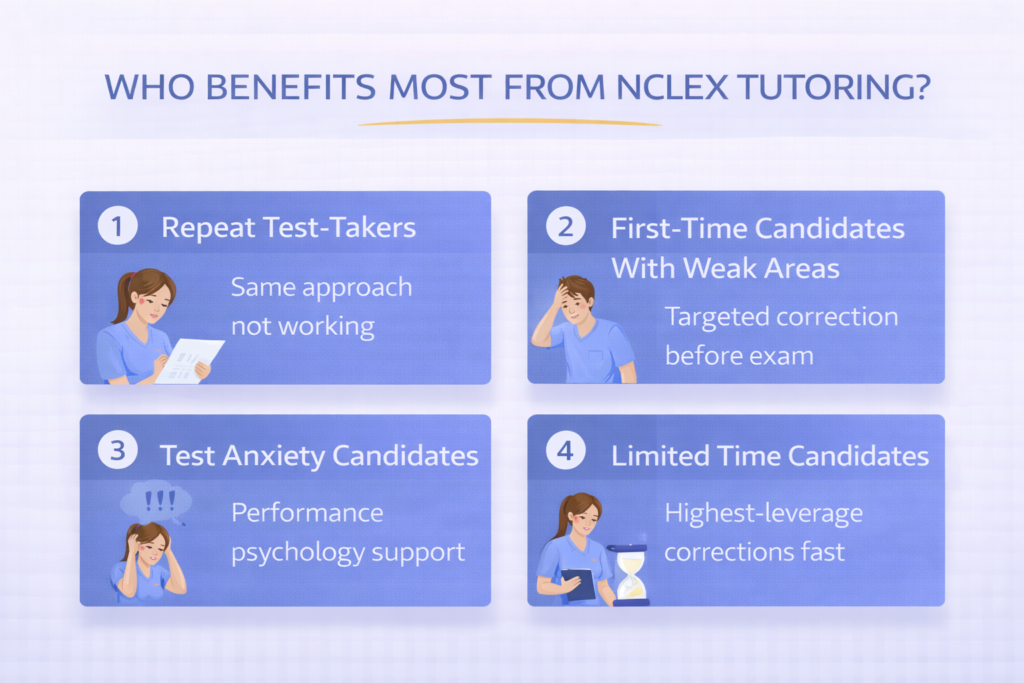
NCLEX tutoring is not the right preparation tool for every candidate in every situation — but for specific candidate profiles, it is the highest-return preparation investment available. Understanding which candidates get the most value from tutoring helps you decide whether it belongs in your preparation system.
Repeat Test-Takers
Repeat test-takers are the candidates who benefit most consistently and most dramatically from NCLEX tutoring. A candidate who has studied extensively, completed thousands of practice questions, and still did not pass has demonstrated that additional self-directed preparation using the same approach is unlikely to produce a different outcome. The NCLEX’s adaptive algorithm is sophisticated enough that a candidate who does not pass despite substantial preparation almost certainly has a specific, identifiable deficit — in reasoning pattern, in clinical judgment framework application, or in a particular content domain — that self-directed study has not corrected. NCLEX tutoring is specifically designed to find and fix that deficit. For repeat test-takers, the question is not whether to add tutoring to the preparation system — it is how to find the right tutor and how quickly to begin.
First-Time Candidates With Identified Weak Areas
First-time candidates who have completed a diagnostic assessment — through a practice question bank, a review course diagnostic, or a nursing school exit exam — and identified one or more content areas with consistently low accuracy are well positioned to benefit from NCLEX tutoring even before their first attempt. A few targeted sessions with a tutor who specializes in the weak content area can produce greater improvement in that area than weeks of additional independent study, because the tutor can identify the specific reasoning error generating the low scores and correct it directly rather than requiring the candidate to diagnose and fix the problem through trial and error.
Candidates With Test Anxiety
For candidates whose performance on practice questions significantly exceeds their performance under timed exam conditions — a pattern that strongly suggests test anxiety rather than content or reasoning deficits — NCLEX tutoring that specifically addresses the psychological and physiological components of exam performance can be transformative. An experienced tutor can work with a candidate on the specific anxiety management strategies, cognitive reframing techniques, and timed practice protocols that reduce exam-day performance disruption. This is a dimension of NCLEX preparation that no review book or practice app addresses effectively, and for candidates where test anxiety is the primary barrier to passing, targeted NCLEX tutoring on exam performance psychology is the highest-value preparation investment available.
Candidates With Limited Time
Candidates who are approaching their exam date with limited remaining preparation time and significant performance gaps benefit from NCLEX tutoring because it is the most efficient path to targeted improvement in a compressed timeline. Rather than spending the remaining weeks working through broad content review in areas that may not be the root cause of the performance gap, a tutor can identify the two or three highest-leverage corrections available in the time remaining and focus every session on those specific areas. Efficiency under time pressure is one of NCLEX tutoring’s most concrete advantages over self-directed preparation.
What to Look for in an NCLEX Tutoring Specialist
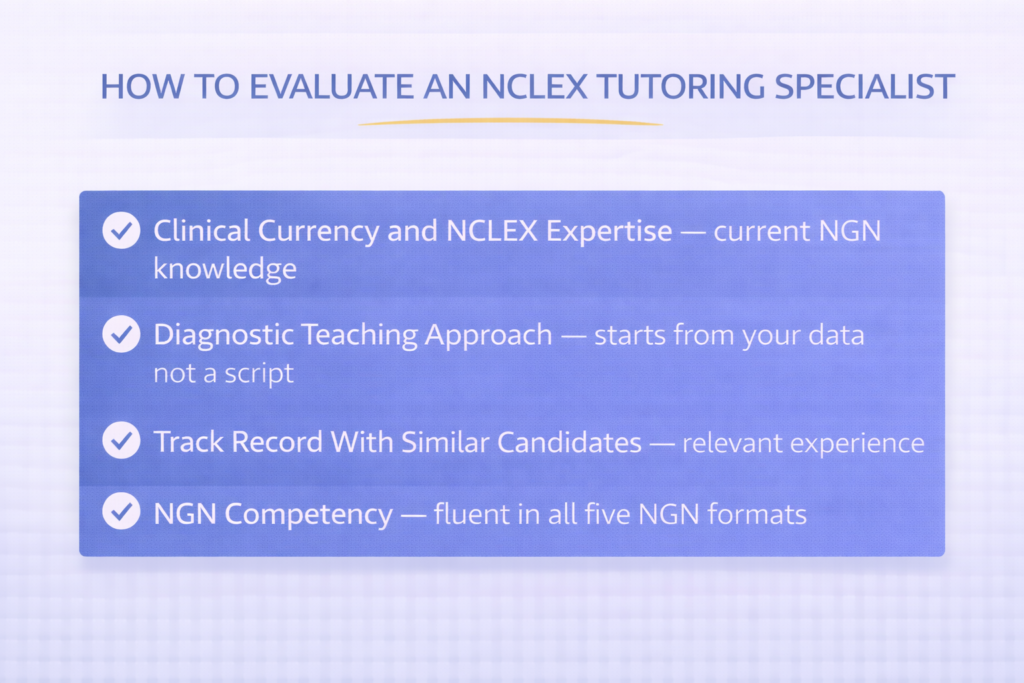
The quality difference between an effective NCLEX tutoring specialist and an ineffective one is substantial, and the credentials that matter most are not always the most prominently marketed. The following criteria identify the tutors most likely to produce genuine improvement in your preparation and your score.
Clinical Currency and NCLEX Expertise
An effective NCLEX tutor must have both current clinical nursing knowledge and specific expertise in how the NCLEX tests that knowledge. A nurse who has not practiced clinically in many years may have outdated pharmacology knowledge, outdated clinical protocols, or insufficient familiarity with the Next Generation NCLEX formats that now appear on every exam. Look for NCLEX tutoring specialists who actively maintain their clinical knowledge, who have specific experience preparing candidates for the current NGN exam, and who can demonstrate fluency with all five NGN question formats — not just the traditional multiple-choice items that dominated the pre-2023 exam.
A Diagnostic Rather Than Prescriptive Teaching Approach
The most important quality to assess in a potential NCLEX tutor is whether their teaching approach is diagnostic — starting from your specific performance data and error patterns — or prescriptive — delivering a standard curriculum regardless of your individual preparation needs. A tutor who begins the first session by reviewing general test-taking strategies without first analyzing your specific performance data and observing your reasoning process is delivering a group instruction format in a one-on-one setting, which is not what effective NCLEX tutoring should be. Ask any potential tutor directly: how do you identify what a specific student needs to work on, and how do you adapt your sessions based on that assessment? The answer reveals whether their approach is genuinely individualized.
Track Record With Candidates Similar to You
An NCLEX tutoring specialist’s track record with candidates who share your specific preparation profile is more relevant than general pass rate claims. A tutor who has helped many repeat test-takers pass after multiple unsuccessful attempts has demonstrated something specific and valuable — the ability to identify the non-obvious root cause of persistent performance gaps. A tutor who primarily works with first-time candidates in accelerated programs has a different expertise profile. Ask potential tutors about their experience with candidates in your specific situation, and ask for testimonials or referrals from candidates with similar preparation histories.
NGN Competency
Given that the Next Generation NCLEX formats now appear on every exam administration, NCLEX tutoring specialists who are not fluent in all five NGN formats are providing incomplete preparation. Ask potential tutors specifically about their NGN teaching approach: how do they teach unfolding case study reasoning, how do they guide candidates through bow tie question strategy, and how do they teach the independent evaluation logic of extended multiple response? A tutor who gives confident, specific answers to these questions has the NGN competency your 2026 preparation requires. A tutor who responds vaguely or redirects to traditional question format strategy may not.
How to Prepare for NCLEX Tutoring Sessions
The preparation you do before each NCLEX tutoring session directly determines how much value you extract from it. Tutors can only work with the information available to them, and arriving at a session with organized performance data, specific questions, and recent practice examples allows the session to spend its time on targeted correction rather than on establishing baseline information that you could have gathered in advance.
Bring Your Performance Data to Every Session
Before every NCLEX tutoring session, export or screenshot your current performance analytics from your practice question platform. Organize your data by content area accuracy and by question format accuracy, noting which areas show the lowest scores and which areas have not improved despite recent focused practice. This data gives your tutor the diagnostic starting point for the session and prevents the first twenty minutes from being spent on a verbal description of what the data can show numerically in seconds. The more granular your performance data — content subcategory accuracy, performance trends over time, NGN versus traditional format accuracy broken out separately — the more precisely your tutor can target the session.
Bring Specific Questions That Stumped You
The most productive NCLEX tutoring session work happens around specific questions that stumped you — questions where you chose an incorrect answer with moderate to high confidence, meaning you were not guessing but reasoning incorrectly. These questions reveal active misconceptions rather than simple knowledge gaps, and active misconceptions are what tutors are most equipped to correct. Before each session, identify two or three questions from your recent practice where you felt confident but answered incorrectly, and bring them to your tutor with your reasoning for each choice articulated as precisely as you can. The tutor’s job is then to identify exactly where your reasoning deviated from correct clinical judgment — a diagnostic that produces targeted, durable correction.
Set a Specific Session Goal
Each NCLEX tutoring session is most productive when it is focused on one or two specific objectives rather than general review. Before each session, identify the specific reasoning pattern, content area, or question format you want to improve, and communicate that objective to your tutor at the start of the session. A session goal of ‘I want to understand why I keep getting cardiovascular prioritization questions wrong even when I know the pathophysiology’ is far more productive than a session without a specific focus. Over the course of multiple sessions, working systematically through a ranked list of specific preparation goals — ordered by their impact on your performance data — produces cumulative improvement that general review sessions cannot replicate.
Integrating NCLEX Tutoring Into Your Complete Preparation System
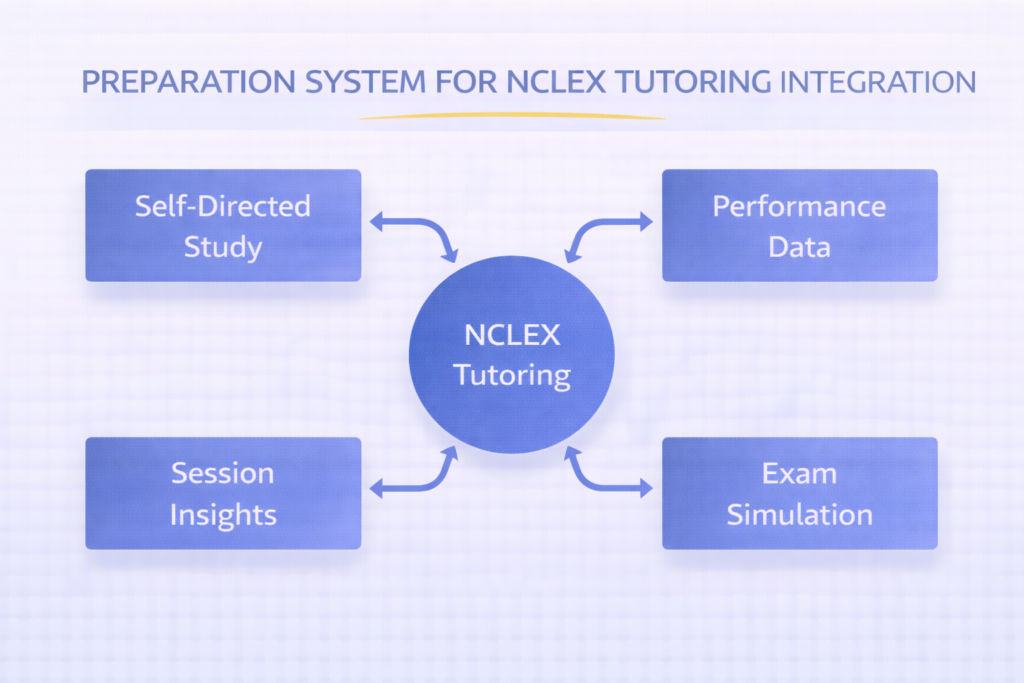
NCLEX tutoring is most effective when integrated into a complete preparation system rather than used as the sole preparation activity. The following framework shows how to position tutoring within a broader preparation approach for maximum impact.
- Use self-directed study to build volume, tutoring to build precision: Self-directed resources — review books, question banks, practice apps — are efficient tools for building content knowledge and question volume. NCLEX tutoring is the tool for converting that content knowledge into accurate clinical reasoning and for correcting the specific errors that self-directed practice is generating but not resolving. The two are complementary: use self-directed study for daily content review and question practice, and use tutoring sessions to analyze the performance patterns that emerge from that practice and correct the root causes of persistent errors.
- Schedule tutoring after you have accumulated meaningful performance data: NCLEX tutoring sessions are most productive when your tutor has real performance data to analyze. Beginning tutoring before you have completed any practice questions gives the tutor no diagnostic material to work with and forces the session to focus on general preparation guidance rather than targeted correction. Complete at least two to three weeks of regular practice question sessions before beginning tutoring, and bring your accumulated performance data to the first session so the diagnostic process can begin immediately.
- Use session insights to redesign your self-directed practice between sessions: The most valuable output of every NCLEX tutoring session is a specific, targeted adjustment to your self-directed preparation — a new clinical reasoning framework to apply to a specific question type, a content area to review from a different resource, a practice habit to change, or a question-reading strategy to implement. Between sessions, implement those adjustments deliberately and track whether your performance data reflects improvement. Report those results at the next session so your tutor can assess whether the correction is working and refine the approach if needed.
- Increase session frequency as the exam approaches: For candidates preparing for an exam within four to six weeks, increasing the frequency of NCLEX tutoring sessions from weekly to twice weekly or more produces the most concentrated improvement in the limited time available. The final two to three weeks before the exam are the highest-leverage window for tutoring-based correction, when your practice question volume is highest, your performance data is most informative, and the time pressure makes efficiency of correction critical.
What to Expect From NCLEX Tutoring Results
Understanding what NCLEX tutoring can realistically produce — and on what timeline — helps you set appropriate expectations, evaluate whether your tutoring relationship is working, and avoid the discouragement that comes from unrealistic expectations in either direction.
- Early sessions focus on diagnosis, not immediate score improvement: The first one or two NCLEX tutoring sessions are primarily diagnostic — your tutor is identifying your error patterns, mapping your content gaps, and building the individualized preparation plan that will drive subsequent sessions. Do not evaluate the effectiveness of your tutoring relationship based on practice scores during this initial diagnostic phase. Score improvement follows from corrective work, and corrective work requires the diagnostic foundation that the early sessions establish.
- Most candidates see measurable improvement within two to three weeks of targeted sessions: Once the diagnostic phase is complete and targeted correction is underway, most candidates working with an effective NCLEX tutoring specialist see measurable improvement in their weak-area accuracy within two to three weeks of regular sessions. The improvement is typically most visible first in the specific content area or question format that the sessions are targeting, then generalizes as the corrected reasoning framework transfers across content areas.
- Tutoring cannot substitute for daily practice volume: NCLEX tutoring improves the quality and precision of your reasoning, but it cannot substitute for the daily practice question volume that builds exam-day stamina and question-answering fluency. Candidates who attend tutoring sessions but complete minimal independent practice between sessions improve more slowly than candidates who combine regular tutoring with consistent daily self-directed practice. The tutor corrects your reasoning; daily practice builds the fluency that makes correct reasoning automatic under exam conditions.
- Repeat test-takers typically need a full preparation cycle with tutoring, not just one or two sessions: For candidates who have not passed after one or more attempts, a single NCLEX tutoring session or a brief two-session engagement is rarely sufficient to produce a passing outcome. A full preparation cycle of four to eight weeks with regular tutoring sessions, redesigned self-directed practice, and consistent performance tracking gives the corrective process enough time to produce durable changes in clinical reasoning that hold up under the pressure of the actual exam.

Conclusion
NCLEX tutoring is the most targeted, most personalized, and most diagnostically precise preparation tool available to nursing students — and for the candidates who need it most, it is also the most effective. Repeat test-takers who have studied extensively without passing, first-time candidates with identified weak areas, candidates struggling with test anxiety, and candidates working against a tight timeline all have compelling reasons to integrate tutoring into their preparation system. The key is finding a tutor with current NGN expertise, a diagnostic rather than prescriptive teaching approach, and a track record with candidates in similar situations.
Prepare for every NCLEX tutoring session by bringing organized performance data and specific stumped questions. Set clear session objectives, implement the tutor’s corrections deliberately between sessions, and track whether your performance data reflects the improvement those corrections should produce. Use tutoring in combination with daily self-directed practice rather than as a substitute for it. With the right tutor, the right preparation integration, and realistic expectations for the timeline of improvement, NCLEX tutoring gives you the most direct path available to the clinical reasoning competency the exam requires — and the confidence that comes from knowing your preparation has been targeted precisely at your specific path to passing.
What is NCLEX tutoring and how does it work?
NCLEX tutoring is personalized one-on-one instruction with a qualified nursing educator or NCLEX preparation specialist focused on building the clinical reasoning competency the exam measures. Sessions are conducted in person or via video call. An effective tutor begins by analyzing your practice question performance data and observing you reason through questions aloud to identify the specific root causes of your errors — content gaps, reasoning framework misapplication, test-taking habits, or clinical judgment deficits. Sessions then focus targeted correction on those specific root causes rather than broad content review, producing more efficient and more durable improvement than self-directed study alone.
Who benefits most from NCLEX tutoring?
The candidates who benefit most from NCLEX tutoring are repeat test-takers who have studied extensively without passing and need a fundamentally different approach; first-time candidates who have identified specific weak content areas through diagnostic assessment; candidates whose practice scores are strong but who underperform significantly under timed exam conditions, suggesting test anxiety; and candidates working against a compressed timeline who need the most efficient path to targeted improvement. For all of these profiles, tutoring’s diagnostic precision produces improvements that self-directed resources cannot replicate.
How do I find a qualified NCLEX tutor?
Look for NCLEX tutoring specialists with current clinical nursing knowledge, demonstrated fluency with all five NGN question formats, a diagnostic rather than scripted teaching approach, and a track record with candidates in situations similar to yours. Ask any potential tutor how they identify what a specific student needs to work on, what their experience with NGN formats is, and whether they can provide referrals from candidates with similar preparation histories. Nursing school faculty, nursing education platforms, and NCLEX-specific tutoring services are the most reliable sources for qualified tutors. Avoid tutors whose marketing emphasizes general test-taking tricks rather than clinical reasoning development.
How many NCLEX tutoring sessions do I need?
The number of sessions depends on your preparation timeline, the complexity of your error patterns, and how quickly your performance data responds to the corrections being implemented. First-time candidates with one or two specific weak areas may benefit substantially from four to six targeted sessions. Repeat test-takers typically need a full preparation cycle of four to eight weeks with regular sessions to produce the durable reasoning changes that a passing outcome requires. Increase session frequency in the final two to three weeks before your exam date to maximize correction in the highest-leverage pre-exam window.
Can NCLEX tutoring help with test anxiety?
Yes — NCLEX tutoring is one of the most effective interventions available for exam-day performance disruption caused by test anxiety. An experienced tutor can work with you on anxiety management strategies, cognitive reframing techniques, timed practice protocols that gradually build exam-day tolerance, and specific pre-exam routines that reduce performance disruption. For candidates whose practice scores significantly exceed their performance under timed exam conditions, addressing the psychological and physiological components of test anxiety through targeted NCLEX tutoring is often more impactful than any additional content review or question practice.
Leave a Reply