
The most effective NCLEX study techniques are not about studying more — they are about studying smarter. Many nursing students spend weeks putting in long hours of preparation and still feel underprepared on exam day, not because they lacked effort but because their study methods were not aligned with how the NCLEX actually tests knowledge and clinical reasoning.
The Next Generation NCLEX is designed to measure your ability to think like a safe, competent nurse — not your ability to memorize facts. That distinction changes everything about how you should prepare. The NCLEX study techniques that work are those that build pattern recognition, strengthen clinical reasoning, and develop the kind of flexible thinking that holds up under adaptive exam pressure.
This guide presents the ten most effective NCLEX study techniques for 2026, grounded in how nurses actually learn and how the exam actually works. Whether you are just beginning your preparation or deep into your final review, these strategies will help you make every study session count.
Why Most Nursing Students Use Ineffective NCLEX Study Techniques
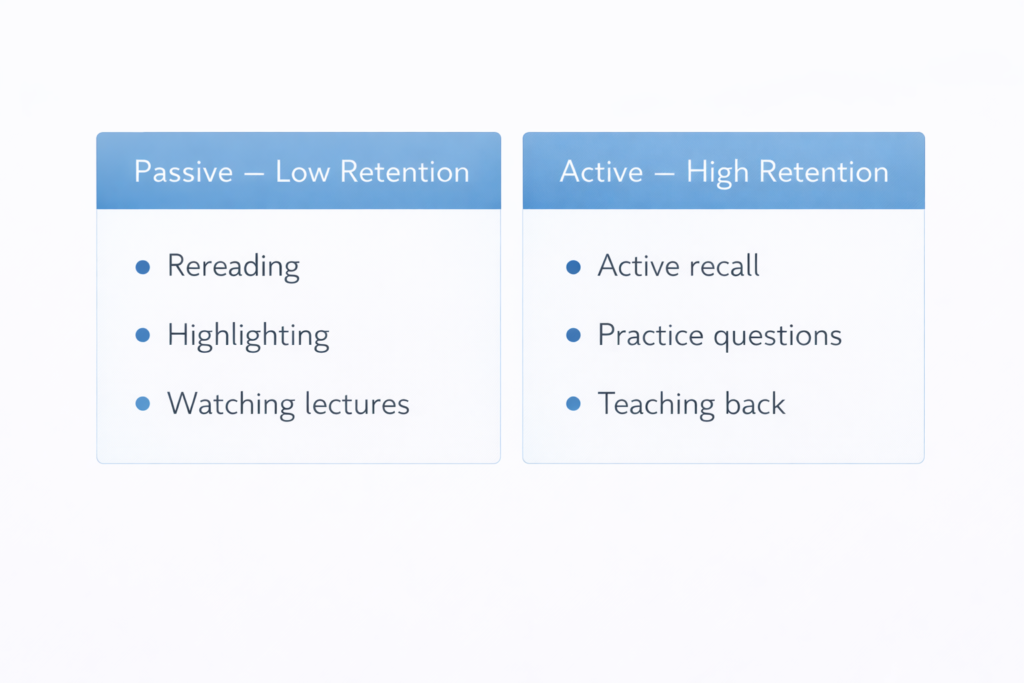
Before diving into what works, it is worth understanding what does not. The majority of nursing students default to passive NCLEX study techniques — rereading textbook chapters, highlighting notes, and watching video lectures without active engagement. These methods feel productive because they are comfortable and familiar, but decades of learning science research consistently show that passive review produces shallow encoding that fades quickly under exam pressure.
The NCLEX does not reward students who can recite information. It rewards students who can apply information to clinical scenarios they have never seen before. That requires a fundamentally different kind of preparation — one built on active recall, spaced repetition, deliberate practice, and reflective reasoning rather than passive exposure to content.
Switching to evidence-based NCLEX study techniques does not mean studying harder. In most cases, it means studying less time with far greater results. Students who adopt active learning strategies consistently report stronger retention, better clinical reasoning, and more confidence on exam day compared to those who rely on passive review methods alone.
The Golden Rule of NCLEX Preparation
Before exploring individual NCLEX study techniques, internalize this principle: the quality of your review is always more important than the quantity of your study hours. One hour of active, focused, reflective studying produces more durable learning than three hours of passive rereading. Every technique in this guide is built on that foundation.
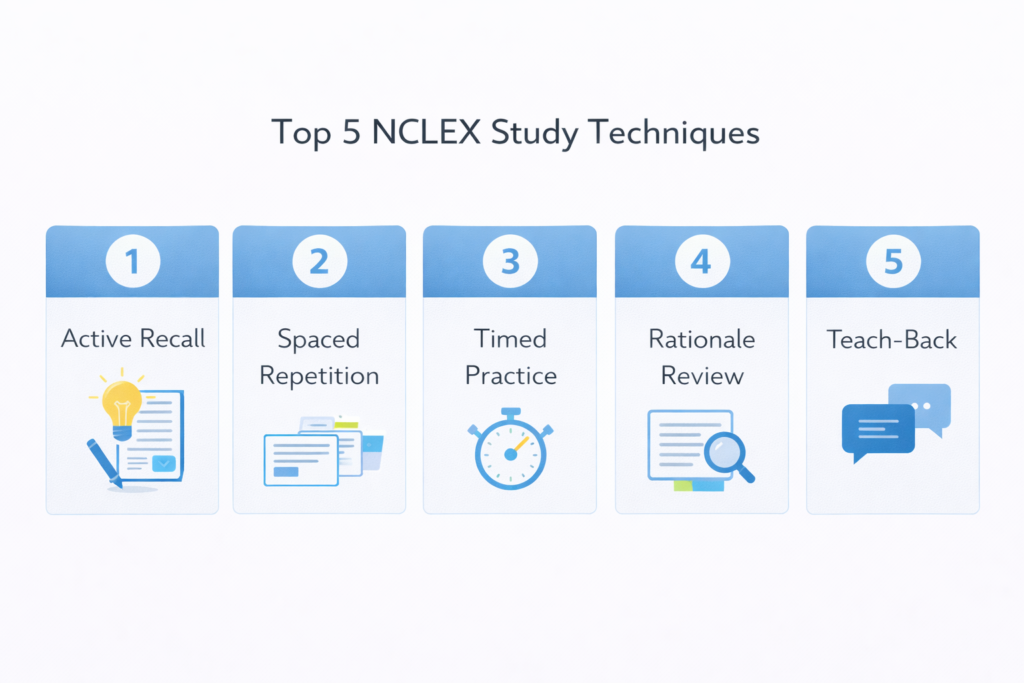
The 10 Most Effective NCLEX Study Techniques for 2026
1. Active Recall Over Passive Review
Active recall is the single most evidence-supported of all NCLEX study techniques. Instead of rereading your notes, close them and try to retrieve the information from memory. After studying a content area, set your materials aside and write down everything you can remember — the clinical presentation, the nursing priorities, the medications, the patient teaching points. Then check your notes and identify what you missed. This retrieval effort strengthens memory far more durably than any amount of rereading, and it trains the same mental process you will use on exam day when you need to retrieve clinical knowledge under pressure.
2. Spaced Repetition
Spaced repetition is one of the most powerful NCLEX study techniques for long-term retention. Instead of studying a topic intensively once and moving on, you review it at increasing intervals over time — for example, reviewing cardiovascular content on day one, again on day three, again on day seven, and again two weeks later. Each review session reinforces the memory trace before it has fully faded, producing retention that holds up across weeks rather than days. Flashcard systems like Anki are built on this principle and can be especially effective for high-yield pharmacology and laboratory values.
3. Deliberate Practice with Timed Question Blocks
Practice questions are among the most essential NCLEX study techniques, but only when done deliberately. Set a timer and work through blocks of 25 to 75 questions without pausing, without notes, and without looking up answers mid-session. Replicate exam conditions as closely as possible. The discomfort of working through questions without a safety net is exactly what builds the cognitive stamina and the clinical confidence that exam day demands. Avoid the habit of doing questions with your review book open — it prevents the productive struggle that drives real learning.
4. Rationale-First Review
This is one of the most underused NCLEX study techniques and one of the highest-yield. After completing a practice question block, spend at least as much time reviewing the rationales as you spent answering the questions. For every question — right or wrong — read the full explanation. Understand why the correct answer is correct and why each distractor is wrong. Over time, this builds a library of clinical reasoning patterns that transfers across new questions you have never seen before, which is precisely what the NCLEX requires.
5. The Teach-Back Method
Teaching a concept to someone else — or to yourself out loud — is one of the most reliable NCLEX study techniques for identifying gaps in your understanding. When you can explain a concept clearly, you truly understand it. When your explanation breaks down or becomes vague, you have found exactly the gap you need to address. After studying a condition, close your notes and explain it as if you are teaching a classmate: what is it, how does it present, what are the nursing priorities, what medications are involved, and what would you monitor? The gaps that surface are your highest-priority review items.
6. Concept Mapping
Concept mapping is one of the most effective NCLEX study techniques for students who struggle to connect isolated facts into a coherent clinical picture. Instead of memorizing a list of symptoms for heart failure, draw a concept map that connects the pathophysiology to the assessment findings, the assessment findings to the nursing priorities, the nursing priorities to the interventions, and the interventions to the expected outcomes. This visual representation mirrors the way clinical judgment actually works — as a web of connected ideas, not a list of memorized facts.
7. Simulated Exam Conditions
Regularly practicing under simulated exam conditions is one of the NCLEX study techniques most directly linked to exam-day performance. Once a week, take a full-length 75 to 145 question practice session with no breaks, no notes, and no phone. Use an interface that resembles the actual NCLEX testing environment as closely as possible. This builds the cognitive stamina to sustain clinical reasoning across a long exam, familiarizes your nervous system with the test format, and reduces the novelty — and therefore the anxiety — of the actual exam day experience.
8. Priority and Delegation Practice
Priority and delegation questions are consistently among the most missed on the NCLEX, which makes targeted practice in this area one of the highest-yield NCLEX study techniques you can use. Practice applying ABC — airway, breathing, circulation — and Maslow’s hierarchy to prioritization scenarios. Study the five rights of delegation and practice identifying which tasks can be safely delegated to an LPN or unlicensed assistive personnel. Build the habit of asking yourself, with every patient scenario: who is the sickest, what needs to happen first, and who is the right person to do it?
9. High-Yield Pharmacology Focus
Pharmacology is tested across every NCLEX content category, making it one of the areas where targeted NCLEX study techniques pay the highest dividends. Rather than trying to memorize every drug, focus your energy on the highest-yield medication classes: antihypertensives, diuretics, anticoagulants, insulin and oral hypoglycemics, antipsychotics, antidepressants, antibiotics, opioids, and cardiac medications. For each class, know the mechanism of action, the most important side effects, the key nursing assessments before administration, and the essential patient teaching points. Pharmacology studied at the class level transfers across individual drug names in a way that memorizing isolated drug facts never does.
10. Daily Reflection and Weak-Area Tracking
The tenth of the essential NCLEX study techniques is the one most students skip: daily reflection and systematic tracking of weak areas. At the end of each study session, spend five minutes writing down the content areas where you struggled, the question types that tripped you up, and any reasoning errors you made. Review this log weekly and use it to deliberately redirect your study time toward your most persistent gaps. Without this tracking, it is easy to spend four weeks reviewing content you already know well while neglecting the areas that will cost you points on exam day. This simple habit is what transforms good preparation into great preparation.

How to Combine NCLEX Study Techniques Into a Daily Study Routine
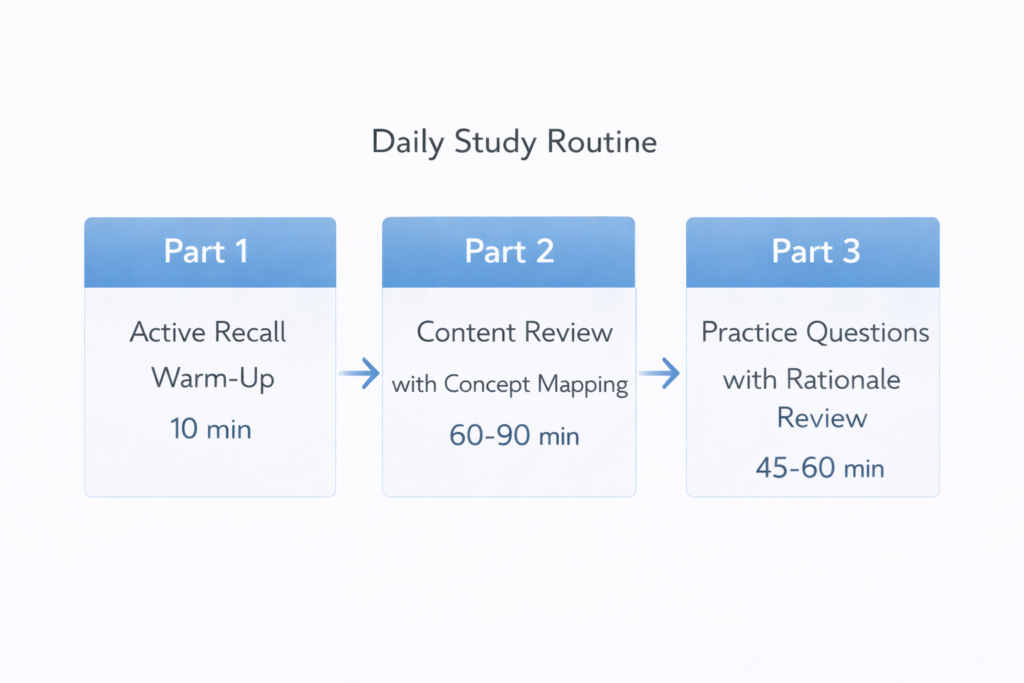
Individual NCLEX study techniques are most effective when combined into a coherent daily study structure. The following framework integrates the ten techniques above into a repeatable session format that maximizes both content retention and clinical reasoning development.
Begin each session with a brief active recall warm-up. Before opening any notes or review materials, spend five to ten minutes writing down everything you remember from your last study session — key conditions, medications, nursing priorities. This retrieval effort activates the material in your memory before you add new information on top of it, which significantly improves the consolidation of both old and new content.
Move into your content review block using teach-back and concept mapping rather than passive rereading. Study one content area deeply, then close your materials and build a concept map or verbal explanation from memory. Identify the gaps, return to your materials to fill them, and repeat. This active engagement cycle — study, retrieve, check, fill gaps — is the engine of effective NCLEX preparation.
End every session with a targeted practice question block followed by thorough rationale review. Match the question content to the material you studied that day whenever possible. This immediate application of new content to clinical scenarios is one of the most powerful NCLEX study techniques for transferring what you learned into the kind of flexible, applicable knowledge the exam actually tests.
Common Mistakes That Make NCLEX Study Techniques Less Effective
Even the best NCLEX study techniques lose their effectiveness when paired with habits that undermine learning. Being aware of these common pitfalls will help you get the maximum return from every study session.
- Studying for too many hours without breaks: Cognitive performance declines sharply after 90 minutes of sustained focused work. Build in short breaks every 60 to 90 minutes to allow your brain to consolidate what it has processed. The Pomodoro method — 25 minutes of focused study followed by a 5-minute break — is a well-supported structure for maintaining concentration across long study sessions.
- Prioritizing quantity of questions over quality of review: Doing 200 practice questions a day means nothing if you are spending 10 seconds on each rationale. The review phase of practice questions is where the actual learning happens. Slow down and think deeply about each explanation.
- Avoiding your weak areas: It is human nature to gravitate toward content you already know because it feels good to get questions right. But spending time on your strengths while neglecting your weaknesses is one of the most common reasons well-prepared students underperform on the NCLEX. Use your weak-area tracking log to deliberately override this tendency.
- Skipping sleep and rest: Memory consolidation happens during sleep. Consistently sacrificing sleep for extra study hours is one of the most counterproductive things you can do during NCLEX preparation. Protect your sleep schedule as an integral part of your NCLEX study techniques, not as a trade-off against them.
- Comparing your progress to other students: Every candidate has different strengths, weaknesses, and starting points. Measuring your preparation against someone else’s creates anxiety without producing useful information. Focus entirely on your own diagnostic data, your own weak-area log, and your own daily progress.
NCLEX Study Techniques for the Final Week Before Exam Day
The final week of NCLEX preparation requires a deliberate shift in your study techniques. This is not the time to introduce new content — it is the time to consolidate, sharpen, and build exam-day readiness.
Complete one full-length simulated exam at the start of the final week under strict exam conditions. Review the full results, identify any remaining weak areas, and spend two focused sessions on targeted review of those specific gaps. After that, shift your daily practice to shorter, mixed-content question blocks of 25 to 50 questions that keep your clinical reasoning sharp without draining your cognitive reserves.
In the final two to three days, scale back study time to no more than two to three hours per day. Use this time for light review of your concept maps, a run through your high-yield pharmacology summaries, and a final pass through your weak-area log to confirm you have addressed the most important gaps. The goal is maintenance and confidence, not cramming.
On the day before your exam, stop studying by early evening. Trust the NCLEX study techniques you have built your preparation on. Review your logistics, eat a good meal, do something restful, and prioritize a full night of sleep. Everything you need is already in place.

Conclusion
The right NCLEX study techniques do not just help you pass — they help you pass faster, with greater confidence and less wasted effort. Active recall, spaced repetition, rationale-first review, teach-back, concept mapping, simulated exam conditions, and deliberate weak-area tracking are not abstract learning theories. They are practical, evidence-based strategies that align directly with what the NCLEX is testing and how your brain best retains and applies clinical knowledge.
Start applying these NCLEX study techniques today, build them into a consistent daily routine, and track your progress honestly along the way. The students who pass the NCLEX efficiently are not necessarily the ones who studied the longest — they are the ones who studied the smartest. With the right techniques and consistent effort, that can absolutely be you.
What are the most effective NCLEX study techniques?
The most effective NCLEX study techniques are active recall, spaced repetition, timed practice question blocks with thorough rationale review, the teach-back method, concept mapping, and simulated exam conditions. These active learning strategies consistently outperform passive methods like rereading and highlighting because they build the flexible clinical reasoning the NCLEX actually tests.
How many practice questions should I do per day for the NCLEX?
Most candidates benefit from 50 to 100 practice questions per day, combined with thorough rationale review after each session. More important than the number is the quality of your review. Spending equal time on rationales as on answering questions produces far stronger learning outcomes than simply maximizing question volume.
Is active recall better than rereading for NCLEX prep?
Yes, significantly. Active recall — retrieving information from memory rather than rereading it — produces stronger, more durable memory encoding and trains the same retrieval process used on exam day. Rereading creates a false sense of familiarity without building the retrieval strength needed to access information under exam pressure.
How do I study pharmacology for the NCLEX effectively?
Focus on medication classes rather than individual drug names, and for each class learn the mechanism of action, key side effects, priority nursing assessments, and essential patient teaching. The highest-yield classes include antihypertensives, anticoagulants, insulin, antipsychotics, diuretics, and opioids. This class-level approach transfers across individual drug questions far more effectively than memorizing isolated drug facts.
How should I change my NCLEX study techniques in the final week?
In the final week, shift from learning new content to consolidating what you know. Complete one full-length simulated exam early in the week, do a targeted review of remaining weak areas, then reduce to shorter mixed-content practice blocks. In the last two to three days, limit study to two to three hours daily. Stop studying the evening before your exam and prioritize sleep above all else.
Leave a Reply