
A well-structured NCLEX study plan is one of the most powerful advantages you can give yourself before sitting for the licensing exam. Many nursing students prepare hard but prepare inefficiently — covering content randomly, spending too much time on comfortable topics, and leaving high-yield areas understudied in the final days before exam day. A strategic four-week plan eliminates that problem entirely.
The Next Generation NCLEX is a rigorous, adaptive exam that tests clinical judgment across a wide range of nursing content. According to the NCSBN, candidates who take a structured, organized approach to their preparation consistently outperform those who study without a plan. Four weeks is enough time to build a complete, confident review — but only if that time is organized thoughtfully and used consistently.
This guide walks you through how to build the perfect NCLEX study plan for 2026, week by week. It covers how to assess your starting point, which content areas to prioritize, how to structure each study day, how to use practice questions effectively, and how to protect your readiness in the final days before your exam.
Why You Need a Structured NCLEX Study Plan Before You Start Studying
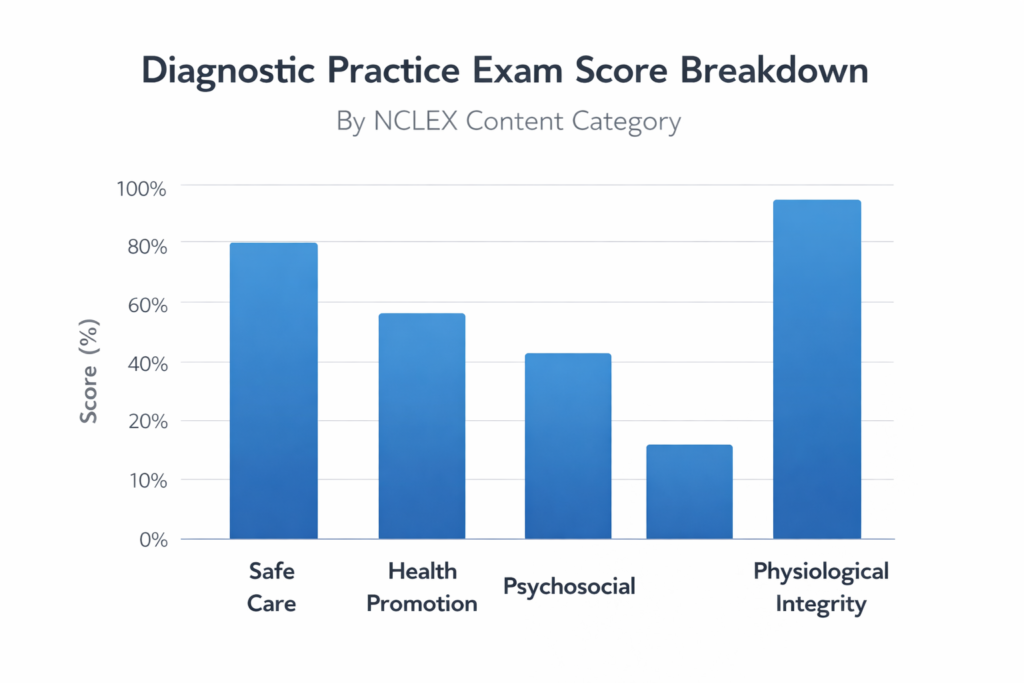
A structured NCLEX study plan is not just a calendar — it is a clinical reasoning tool applied to your own preparation. Without one, most students default to studying whatever feels most comfortable or most urgent in the moment, which leads to uneven coverage, mounting anxiety, and a genuine risk of arriving at exam day with blind spots in critical content areas.
The NCLEX tests content across eight major client needs categories: safe and effective care environment, health promotion and maintenance, psychosocial integrity, and physiological integrity — which itself includes four subcategories. A good NCLEX study plan ensures that each of these categories receives deliberate attention proportional to its weight on the exam, not proportional to how much you enjoyed studying it in nursing school.
A structured plan also addresses one of the most underappreciated factors in NCLEX preparation: spacing. Research on learning and memory consistently shows that spaced repetition — reviewing content across multiple sessions separated by time — produces far stronger retention than massed studying. Building review cycles into your NCLEX study plan from the start means you are encoding information in a way that will actually hold on exam day.
How to Assess Your Starting Point Before Building Your NCLEX Study Plan
Before you write a single study block into your calendar, take a diagnostic practice exam of at least 75 questions under timed conditions. Do not study for it beforehand. The goal is an honest picture of where your clinical reasoning currently stands across content categories. Review the breakdown of correct and incorrect answers by category. This data becomes the foundation of your NCLEX study plan — the categories where your performance is weakest get the most dedicated time, and the categories where you are already strong get maintenance review rather than deep study.
NCLEX Study Plan Week 1: Content Foundation and High-Yield Systems
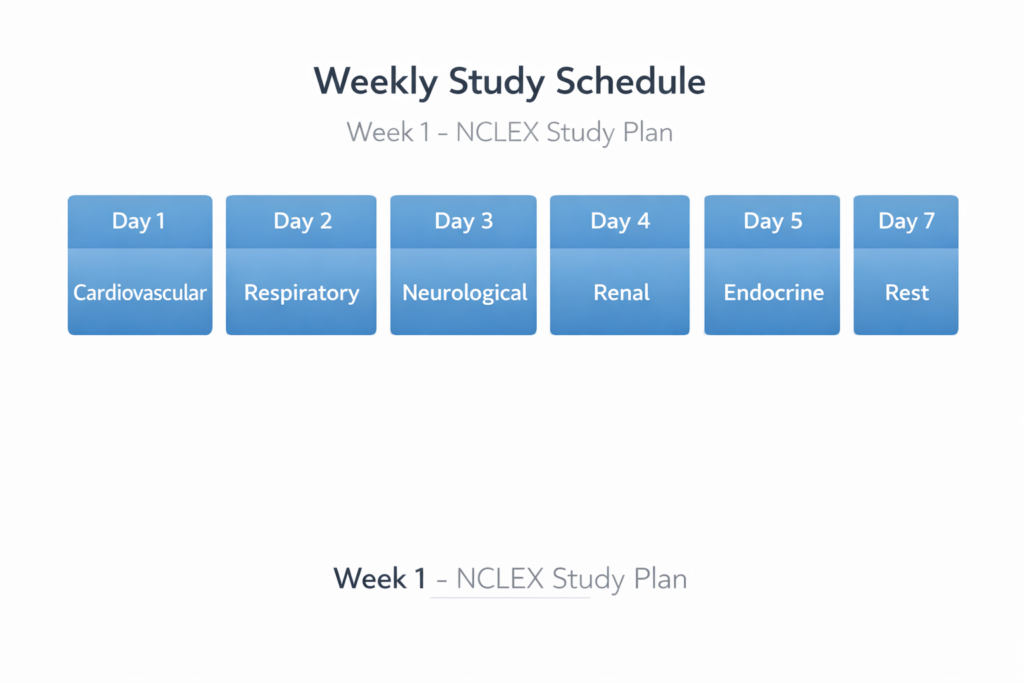
The first week of your NCLEX study plan is dedicated to building and reinforcing your content foundation across the highest-yield body systems and nursing concepts. This is not the week for practice questions to dominate — it is the week for active content review with practice questions used at the end of each session to test comprehension.
Day-by-Day Focus for Week 1
- Day 1 — Cardiovascular: Review heart failure, cardiac dysrhythmias, hypertension, angina, myocardial infarction, and peripheral vascular disease. Focus on the nursing assessment findings, priority interventions, and medication classes for each condition.
- Day 2 — Respiratory: Cover pneumonia, COPD, asthma, pulmonary embolism, acute respiratory distress syndrome, and tuberculosis. Know the distinguishing clinical features and the nursing actions that follow from each diagnosis.
- Day 3 — Neurological: Review increased intracranial pressure, stroke, seizure disorders, spinal cord injury, meningitis, and Guillain-Barré syndrome. Know the priority nursing assessments and the time-sensitive interventions for stroke and seizure management.
- Day 4 — Renal and Fluid/Electrolytes: Cover acute kidney injury, chronic kidney disease, the most commonly tested electrolyte imbalances — sodium, potassium, calcium, and magnesium — and their clinical presentations and nursing management.
- Day 5 — Endocrine: Focus on diabetes mellitus including DKA and HHS, thyroid disorders, Addison’s disease, and Cushing’s syndrome. Know the distinguishing assessment findings and the nursing priorities for each endocrine emergency.
- Day 6 — Pharmacology Review: Review the highest-yield medication classes from the week’s content: antihypertensives, diuretics, anticoagulants, bronchodilators, insulin, and antiepileptics. For each class, know the mechanism, key side effects, and priority nursing teaching.
- Day 7 — Rest and Light Review: Take a genuine rest day. If you choose to study, limit yourself to no more than one hour of light review — flashcards or brief reading — with no timed practice exams.
End each study day with 20 to 30 targeted practice questions on that day’s content area. Review every rationale, not just the questions you answered incorrectly. This daily practice integration reinforces the content while beginning to build your clinical reasoning patterns.
NCLEX Study Plan Week 2: Expanding Content and Increasing Practice Volume
Week 2 of your NCLEX study plan shifts the balance toward practice questions while continuing new content review. You should be completing 50 to 75 practice questions daily by midweek, reviewing all rationales, and spending as much time on the review as on the questions themselves.
Day-by-Day Focus for Week 2
- Day 8 — Gastrointestinal: Cover inflammatory bowel disease, peptic ulcer disease, liver cirrhosis, hepatitis, bowel obstruction, and ostomy care. Focus on the nursing assessment findings and the dietary and medication management priorities.
- Day 9 — Musculoskeletal and Integumentary: Review fractures, compartment syndrome, osteoporosis, rheumatoid arthritis, burn injury classification and fluid resuscitation, and wound care priorities.
- Day 10 — Oncology and Immunology: Cover chemotherapy side effects and nursing management, neutropenic precautions, blood transfusion reactions, and HIV/AIDS nursing care priorities.
- Day 11 — Mental Health: Review therapeutic communication, suicide risk assessment, schizophrenia and antipsychotics, mood disorders and lithium therapy, anxiety disorders, and legal and ethical concepts in psychiatric nursing.
- Day 12 — Maternal Newborn: Cover preeclampsia, fetal heart rate interpretation, postpartum hemorrhage, the BUBBLE-HE assessment framework,
- Day 13 — Pediatrics: Review growth and development milestones, Erikson’s stages, croup versus epiglottitis, congenital heart defects, and pediatric immunization schedules.
- Day 14 — Rest and Reflection: Rest, then spend thirty minutes reviewing your practice question performance data from the week. Note which content areas produced the most errors and flag them for additional attention in Week 3.
NCLEX Study Plan Week 3: Targeted Weakness Review and NGN Question Practice

Week 3 is the most critical week of your NCLEX study plan. By now you have covered the major content areas, accumulated significant practice question data, and have a clear picture of where your weaknesses lie. This week is dedicated to addressing those weaknesses directly while also shifting your practice toward Next Generation NCLEX question formats.
Prioritize Your Identified Weak Areas
Spend the first three days of Week 3 in deep review of the content categories where your diagnostic and practice performance has been weakest. Do not spread this time across everything — concentrate it. If your cardiovascular pharmacology was a consistent weak point, spend a full day on it. If fetal heart rate interpretation cost you points repeatedly, dedicate a morning session entirely to working through strip interpretation practice. Targeted revision at this stage of your NCLEX study plan produces far greater gains than another pass through content you already understand well.
Shift to NGN-Format Practice
From Day 17 onward, shift your daily practice question blocks to include Next Generation NCLEX formats: unfolding case studies, bow tie questions, extended multiple response, and matrix-style items. Work through full six-question unfolding case studies without pausing between questions. Practice navigating the EHR-style interface by using the free sample NGN questions available on the NCSBN website. The goal is to make the NGN question formats feel familiar and manageable before exam day, not novel and threatening.
Increase Daily Practice Volume
By Week 3 of your NCLEX study plan, you should be completing 75 to 100 practice questions daily. Track your performance by category and by question type. If your percentage correct is plateauing, the bottleneck is almost always in your rationale review — you are answering questions but not deeply processing why each answer is right or wrong. Slow down the review phase if needed. Fewer questions with thorough rationale analysis outperforms more questions with cursory review every time.
NCLEX Study Plan Week 4: Final Review, Confidence Building, and Exam Readiness
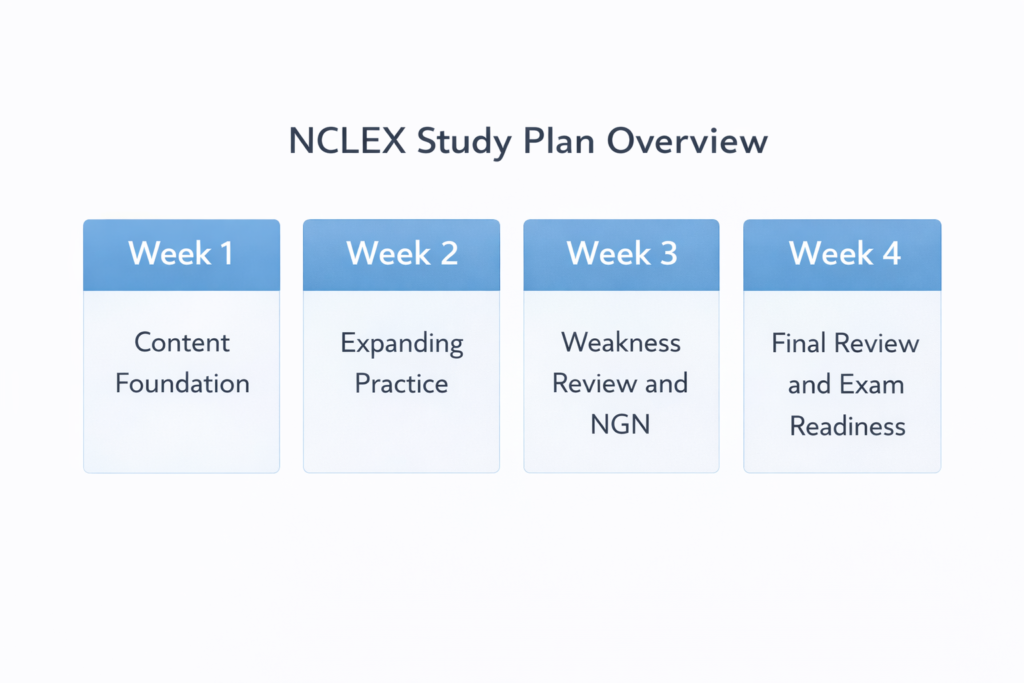
The final week of your NCLEX study plan is not for learning new content. It is for consolidating what you know, building exam-day confidence, and ensuring your mind and body are in peak condition for the test. Students who introduce new material in the final week often increase their anxiety without improving their performance.
Days 22 to 25: Consolidation and Full-Length Practice
Complete one full-length 145-question practice exam under strict timed conditions. Treat it exactly as you would treat the real NCLEX: no notes, no breaks beyond what the exam allows, and no interruptions. Review the entire exam afterward with deliberate focus on the questions you found most difficult. This exercise serves two purposes: it identifies any remaining content gaps that need a final focused review session, and it gives your brain a complete dress rehearsal of the exam-day cognitive demand.
Days 26 to 27: Final Targeted Review and Light Practice
Use these two days for light, targeted review of your most persistent weak areas — no more than three to four hours of study per day. Do 30 to 40 practice questions to keep your reasoning sharp, but avoid the temptation to cram new pharmacology lists or memorize obscure facts. At this point in your NCLEX study plan, rest and consolidation are more valuable than any additional content.
Day 28: The Day Before Your Exam
Stop studying by early evening. Your NCLEX study plan for today is simple: prepare your logistics, eat well, do something genuinely restful, and get a full night of sleep. Trust the four weeks of structured, intentional preparation you have completed. Everything you need is already in place.
Essential Tips to Make Your NCLEX Study Plan Actually Work
Even the most well-designed NCLEX study plan will underperform if it is not supported by strong daily habits. The following principles are what separate candidates who follow a plan and still feel underprepared from those who follow a plan and arrive at exam day genuinely ready.
Protect your study time like a clinical shift. When a study block is on your calendar, treat it with the same commitment you would give a scheduled work shift. Interruptions, distractions, and rescheduling should be the exception, not the norm. Four weeks of consistent, focused effort compounds into a level of readiness that scattered, inconsistent studying simply cannot produce.
Review rationales out loud or in writing. The most common waste of practice question time is reading the correct answer and moving on. The learning lives in the rationale — specifically in understanding the clinical reasoning that makes the correct answer correct and each incorrect answer wrong. Writing out or speaking the reasoning aloud after each question significantly improves retention and builds the kind of transferable thinking patterns the NCLEX rewards.
Build sleep and rest into your NCLEX study plan from day one, not as an afterthought. Sleep is when your brain consolidates the information you reviewed during the day. Chronic sleep restriction during exam preparation impairs exactly the kind of complex reasoning the NCLEX demands — and no amount of extra study time compensates for a sleep-deprived brain on exam day. Six to eight hours of sleep per night is part of your preparation strategy, not a luxury.

Conclusion
A well-executed NCLEX study plan does not just help you cover more content — it transforms the quality of your preparation, reduces test anxiety, and gives you genuine confidence on exam day. The four-week framework in this guide is designed to take you from wherever you are right now to a place of real readiness: strong foundational knowledge, practiced clinical reasoning, familiarity with NGN question formats, and a clear head when you sit down at the testing center.
Start with a diagnostic assessment, build your schedule around your actual weak areas, protect your daily study time, practice with purpose, and treat rest as a non-negotiable part of your NCLEX study plan. Thousands of nurses have passed this exam using exactly this kind of structured, deliberate approach. With four focused weeks and the right strategy, you are fully capable of being one of them.
How many weeks should I study for the NCLEX?
A four-week NCLEX study plan is sufficient for most candidates who are studying full-time. Students who are working or have other significant commitments may benefit from a six to eight week plan with reduced daily study hours. The key is consistency and quality of review, not total hours alone.
How many practice questions should I do per day for the NCLEX?
In the first week of your NCLEX study plan, aim for 20 to 30 targeted questions per day after content review. By Week 2, increase to 50 to 75 questions daily. By Week 3, aim for 75 to 100. Always spend as much time reviewing rationales as you spend answering questions — the review phase is where the real learning happens.
What is the most important content to study for the NCLEX?
The highest-yield NCLEX content areas are cardiovascular nursing, respiratory nursing, neurological nursing, pharmacology, fluid and electrolyte management, mental health nursing, and maternal newborn nursing. Your individual NCLEX study plan should allocate extra time to whichever of these areas your diagnostic exam identifies as your weakest.
Should I study every day for the NCLEX?
Yes, with one planned rest day per week built into your NCLEX study plan. Daily consistency is more effective than occasional long sessions, and a weekly rest day allows for mental recovery and memory consolidation. Avoid studying on the evening before your exam — rest and sleep are more valuable at that point than any additional review.
How do I know if my NCLEX study plan is working?
Track your practice question performance by category each week. You should see your correct percentage improving in your identified weak areas by Week 2 and 3. If performance is plateauing, slow down your rationale review and focus on deeply understanding the reasoning behind each answer rather than increasing question volume.
Leave a Reply