
NCLEX study mistakes are far more common than most nursing students realize — and far more costly. Many candidates spend weeks in preparation, put in genuine effort, and still find themselves underprepared on exam day not because they studied too little, but because they studied the wrong way. Identifying and correcting these mistakes early is one of the highest-leverage things you can do to improve your chances of passing.
The Next Generation NCLEX is a clinical judgment exam, not a knowledge recall test. That distinction means that preparation habits which worked in nursing school — rereading notes, memorizing drug lists, reviewing content passively — are often the exact habits that lead to poor NCLEX performance. The exam rewards students who can think like a nurse under pressure, and it punishes preparation strategies that prioritize coverage over reasoning.
This guide breaks down the biggest NCLEX study mistakes that nursing students make in 2026, explains why each one undermines your preparation, and gives you a clear, actionable strategy to avoid it. Whether you are just beginning your prep or already several weeks in, correcting even one or two of these mistakes can meaningfully shift your trajectory before exam day.
Why NCLEX Study Mistakes Are So Costly
Unlike most exams, the NCLEX does not allow you to compensate for poor preparation strategy with raw effort on exam day. The computer adaptive format presents questions calibrated to your reasoning level in real time — there is no section you can skip, no question type you can avoid, and no opportunity to go back and revisit earlier answers. Every decision you make during the exam is a direct product of the preparation habits you built in the weeks before it.
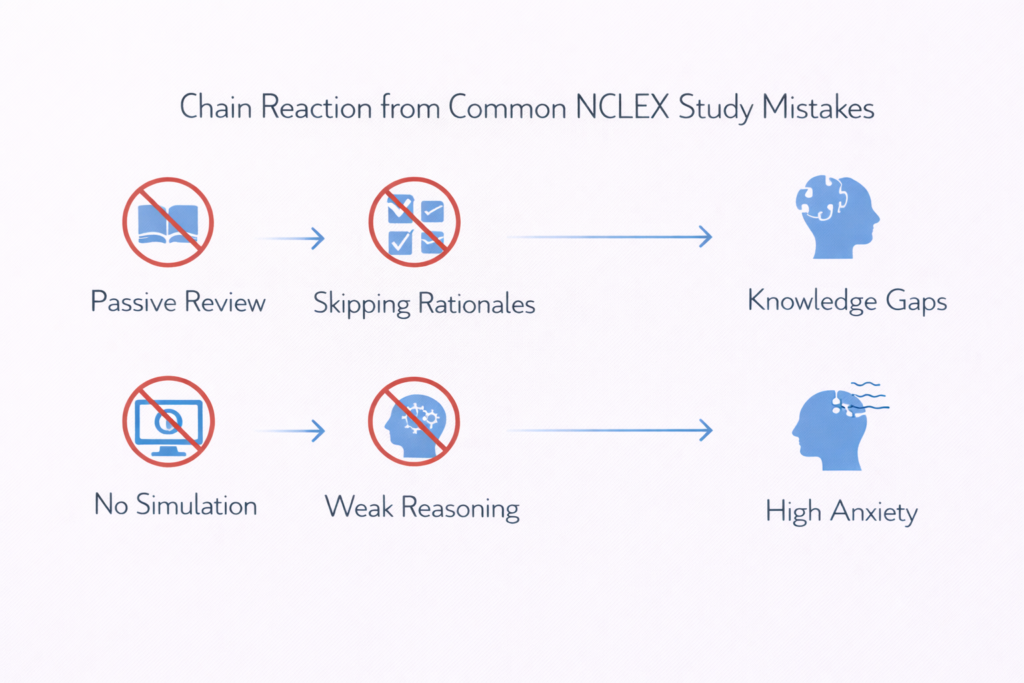
This makes NCLEX study mistakes uniquely damaging. A student who spends four weeks studying hard but inefficiently may arrive at the testing center with genuine knowledge gaps in high-yield content areas, underdeveloped clinical reasoning skills, no familiarity with NGN question formats, and significant test anxiety from a lack of simulated exam experience. Each of these outcomes is directly traceable to specific, correctable preparation mistakes.
The encouraging reality is that most NCLEX study mistakes follow predictable patterns. They are not random failures — they are systematic habits that can be identified, interrupted, and replaced with strategies that actually work. Understanding what those mistakes are is the first step toward a preparation strategy that gives you a real advantage on exam day.
The Relationship Between Study Habits and NCLEX Outcomes
Research in nursing education consistently shows that candidates who use active, structured, evidence-based preparation strategies significantly outperform those who rely on passive review and unguided practice. The difference is not intelligence or work ethic — it is the quality of the study approach. Correcting NCLEX study mistakes is not about studying more. It is about studying differently, with methods aligned to how the exam actually works and how memory actually functions under pressure.
Mistake 1: Relying on Passive Study Methods
The most widespread of all NCLEX study mistakes is defaulting to passive preparation — rereading textbook chapters, watching video lectures without note-taking or recall practice, and highlighting content without any active engagement. These methods feel productive because they are familiar and comfortable, but they produce shallow memory encoding that collapses under the pressure of an adaptive exam.
The NCLEX does not ask you to recognize information you have seen before. It asks you to apply clinical reasoning to scenarios you have never encountered. Passive review prepares you to feel familiar with content — not to think with it. The fix is to replace passive habits with active ones: after every study block, close your materials and retrieve everything you remember by writing it down or explaining it aloud. Use that retrieval attempt to identify gaps, then return to your materials to fill them. This active recall cycle produces retention that holds up on exam day in a way passive review never does.
Mistake 2: Doing Practice Questions Without Reviewing Rationales
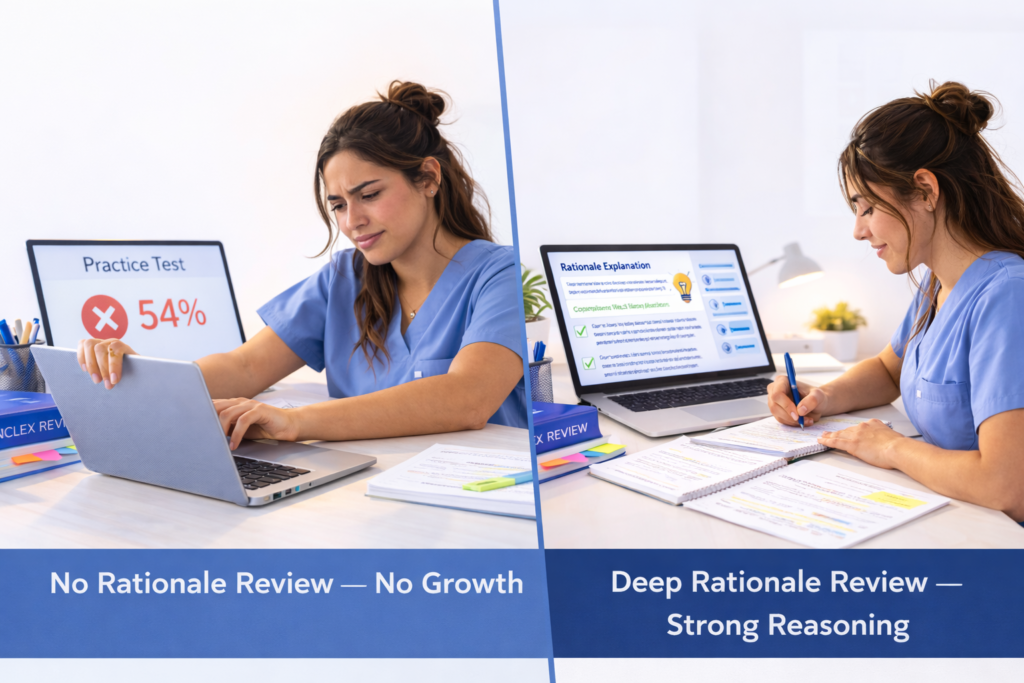
Doing practice questions without reading the rationales is one of the most common and damaging NCLEX study mistakes. Many students complete large question banks, check their score, and move on — treating practice questions as a performance test rather than a learning tool. This approach produces almost no improvement in clinical reasoning over time.
The learning in NCLEX practice questions lives entirely in the rationale review. Understanding why the correct answer is correct, why each distractor is wrong, and what clinical reasoning pattern the question is testing is what builds the transferable reasoning skills the NCLEX rewards. The rule is simple: spend at least as much time reviewing rationales as you spend answering questions. For a 50-question session that takes 60 minutes to complete, budget another 60 minutes for thorough rationale review. Students who follow this discipline consistently outperform those who prioritize question volume over review quality.
How to Review Rationales Effectively
Effective rationale review is not passive reading — it is active analysis. For every question, ask yourself: what clinical concept was being tested, what reasoning led to the correct answer, and what would have changed if one detail in the scenario were different? Writing a brief note on any question where your reasoning was wrong — even if you guessed correctly — builds the pattern recognition that transfers across new questions.
Mistake 3: Studying Content Without a Priority Order
Approaching NCLEX preparation without a clear content priority order is one of the structural NCLEX study mistakes that costs candidates the most time. The NCLEX tests content across four major client needs categories with very different percentage weights. Physiological integrity alone accounts for approximately 38 to 62 percent of the exam. Safe and effective care environment accounts for another 15 to 21 percent. Students who study all content areas equally — or who follow the order of their nursing school curriculum — often arrive at exam day having spent significant time on low-yield topics while leaving high-yield areas underprepared.
The fix is to build your study schedule around the NCSBN test plan. Download the current test plan from the NCSBN website and use the percentage weights to allocate your study time proportionally. Physiological integrity content — cardiovascular, respiratory, neurological, renal, endocrine, and pharmacology — should anchor your preparation. Safe care environment content, particularly delegation, prioritization, and infection control, should be woven throughout every week. Lower-weight categories receive focused but proportionally smaller blocks of study time.
Mistake 4: Deferring Pharmacology Until the End
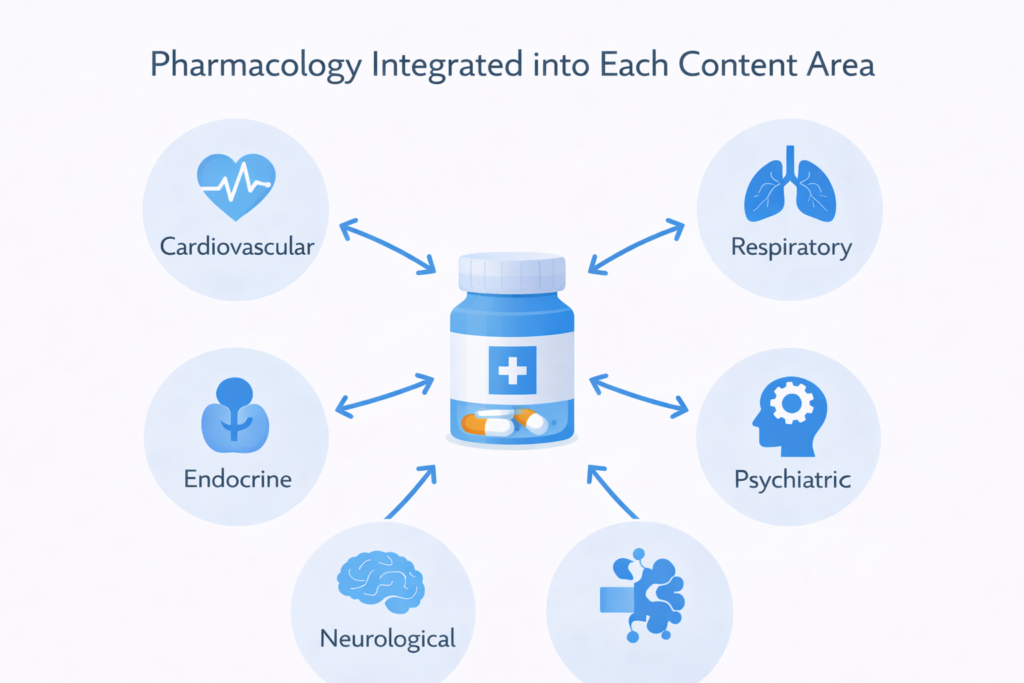
Deferring pharmacology study until the final days of preparation is one of the most stressful NCLEX study mistakes a candidate can make. Pharmacology is not a standalone NCLEX category — it is embedded across every content area on the exam. Cardiovascular questions test antihypertensives and anticoagulants. Psychiatric questions test antipsychotics and lithium. Endocrine questions test insulin and oral hypoglycemics. Leaving all of this until the last week produces a panicked, superficial review of one of the highest-yield areas on the exam.
The solution is to integrate pharmacology study into every content area from day one. When you study heart failure, study the diuretics and ACE inhibitors used to manage it at the same time. When you study seizure disorders, study the antiepileptic medications alongside the nursing management. This contextual approach builds medication knowledge that is anchored to the clinical scenarios where it is tested, which is far more durable and more useful on exam day than a disconnected pharmacology review session crammed into the final week.
The Highest-Yield Drug Classes to Prioritize
Rather than trying to memorize every medication, focus on the classes tested most heavily: anticoagulants including heparin and warfarin, antihypertensives, diuretics, insulin and oral hypoglycemics, opioids and reversal agents, antipsychotics, mood stabilizers including lithium, antibiotics and their major side effect profiles, and cardiac medications including digoxin. For each class, know the mechanism of action, key side effects, priority nursing assessment before administration, and essential patient teaching points.
Mistake 5: Ignoring the Next Generation NCLEX Question Formats
Preparing exclusively with traditional multiple-choice questions and encountering NGN formats for the first time on exam day is one of the most avoidable NCLEX study mistakes in 2026. The Next Generation NCLEX introduced new question types — unfolding case studies, bow tie questions, extended multiple response, matrix items, and enhanced hot spot questions — that test clinical judgment in ways that traditional questions do not. Students who have never practiced these formats before exam day face a significant cognitive disadvantage in the testing room.
The fix is straightforward: build NGN format practice into your preparation from the beginning, not the final week. The NCSBN provides free sample NGN questions on their website that are the most authentic practice resource available. Work through full six-question unfolding case studies without pausing between questions to build the stamina to follow an evolving patient scenario. Practice bow tie questions specifically, as they require you to connect three distinct clinical reasoning steps — the condition most likely present, the actions to take, and the parameters to monitor — in a single integrated response.
Mistake 6: Not Simulating Exam Conditions During Practice
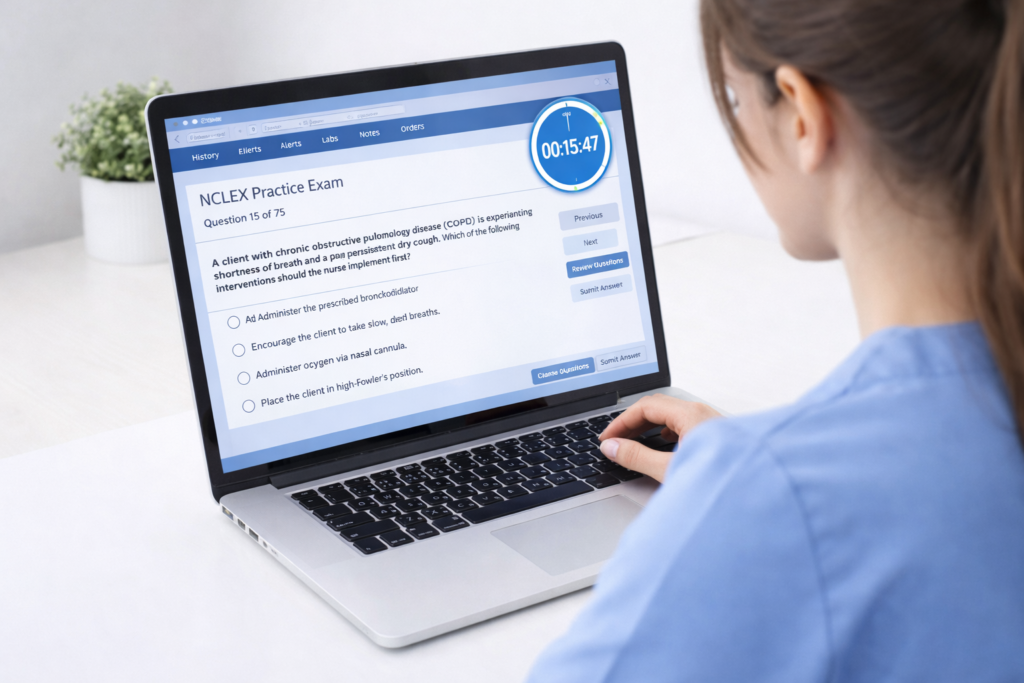
Studying exclusively in low-pressure conditions — with notes nearby, no timer, pausing between questions to look things up — is one of the preparation NCLEX study mistakes most directly linked to exam-day anxiety and performance problems. The actual NCLEX is timed, adaptive, and takes place in a controlled testing environment with no reference materials and no ability to pause. Students who have never practiced under those conditions often experience a significant performance gap between their practice scores and their exam day experience.
Build simulated exam conditions into your preparation at least once per week. Set a timer, work through a 75-question block without notes or phone, and replicate the testing environment as closely as possible. This builds cognitive stamina, familiarizes your nervous system with the exam format, and ensures that the actual test day feels practiced rather than novel. The discomfort of working without a safety net during practice is exactly what prepares you to work confidently without one on exam day.
Mistake 7: Studying Strong Areas Instead of Weak Ones
One of the most psychologically understandable NCLEX study mistakes is spending the majority of study time on content you already know well. Getting practice questions right feels good, and it is tempting to gravitate toward familiar topics where performance is strong. But studying your strengths while neglecting your weaknesses is a preparation strategy that actively works against you on an adaptive exam that will probe your weakest areas relentlessly.
The solution is systematic weak-area tracking from the very first day of preparation. After each study session, note which content areas produced the most errors. After each practice question block, review your performance breakdown by category. Use this data to deliberately redirect your study time toward your most persistent gaps. At least half of every study week should be allocated to content areas where your practice performance is below target. Comfort is not the goal of NCLEX preparation — readiness is, and readiness requires honest engagement with your weakest content.
Mistake 8: Sacrificing Sleep for Extra Study Hours
Consistently cutting sleep to extend study sessions is one of the NCLEX study mistakes with the most direct and measurable impact on exam performance. Memory consolidation — the process by which the information you studied during the day is encoded into long-term memory — happens during sleep. Chronic sleep restriction during exam preparation means that the content you review each day is not being properly consolidated, which is why many students feel like they cannot retain information no matter how many hours they put in.
Sleep deprivation also directly impairs the prefrontal cortex function that clinical reasoning depends on — the same cognitive capacity the NCLEX tests. Arriving at the testing center after several nights of poor sleep means arriving with impaired working memory, slower processing speed, and reduced ability to evaluate complex clinical scenarios. Six to eight hours of sleep per night is not a luxury to be traded away for extra study time — it is a foundational component of effective NCLEX preparation.

Conclusion
NCLEX study mistakes do not happen because nursing students are unprepared or uncommitted — they happen because the habits that worked in nursing school are often the wrong habits for this particular exam. Passive review, skipping rationale analysis, studying without priority order, deferring pharmacology, avoiding NGN formats, practicing without time pressure, gravitating toward comfortable content, and sacrificing sleep are all correctable patterns. Recognizing them is the first step toward replacing them with strategies that genuinely work. The most effective NCLEX preparation is active, structured, rationale-driven, and aligned with the test plan. It integrates pharmacology from day one, includes NGN format practice from the start, simulates exam conditions weekly, tracks weak areas deliberately, and protects sleep as a non-negotiable part of the process. Correct these NCLEX study mistakes now — before exam day — and you give yourself every advantage the preparation phase can provide.
What is the most common NCLEX study mistake?
The most common NCLEX study mistake is relying on passive study methods — rereading notes, watching lectures without active recall, and highlighting content without engaging with it. These methods produce shallow memory encoding that does not hold up under exam pressure. Replacing passive habits with active recall and deliberate practice question review produces dramatically stronger results.
Why do nursing students fail the NCLEX even when they study hard?
Most NCLEX failures among hard-working students trace back to specific study mistakes: studying without a content priority order, skipping rationale review after practice questions, avoiding simulated exam conditions, and deferring pharmacology until the end. The NCLEX rewards clinical reasoning, not content coverage — and preparation strategies that do not develop that reasoning are the root cause of most unexpected failures.
How important is rationale review for NCLEX preparation?
Rationale review is one of the most important parts of NCLEX preparation and one of the most commonly skipped. The reasoning patterns that rationale review builds are exactly what the NCLEX tests — the ability to understand why one clinical action is correct and others are not. Spending equal time on rationale review as on answering questions is a minimum standard for effective preparation.
When should I start practicing NGN question formats?
From the beginning of your preparation — not the final week. NGN formats including unfolding case studies, bow tie questions, and extended multiple response items require familiarity to navigate efficiently. Encountering them for the first time on exam day is one of the most avoidable NCLEX study mistakes. Use the free sample NGN questions on the NCSBN website to build that familiarity early.
Does sleep really affect NCLEX performance?
Yes, significantly. Sleep is when memory consolidation happens — the process that converts what you studied during the day into durable long-term memory. Sleep deprivation also directly impairs the prefrontal cortex function that clinical reasoning depends on. Sacrificing sleep for extra study hours is one of the NCLEX study mistakes with the most direct and measurable impact on exam day performance.
Leave a Reply