
NCLEX SATA questions — Select All That Apply items — are among the most feared question formats on the licensing exam, and for good reason. Unlike traditional four-option multiple-choice questions where only one answer is correct, SATA questions require you to evaluate every option independently and select every clinically accurate response. There is no partial credit on traditional SATA items — you must identify all correct options and none of the incorrect ones to receive full credit.
The fear most nursing students feel toward NCLEX SATA questions is understandable, but it is largely the product of a misguided approach. Students who treat SATA questions like multiple-choice questions — looking for the single best answer or trying to identify a pattern in the options — will consistently miss them. Students who understand that SATA questions require a fundamentally different evaluation strategy, and who practice that strategy deliberately, find that these questions become one of their most confident question types rather than their most dreaded.
This guide explains exactly what NCLEX SATA questions are, why they are designed the way they are, and how to approach them with a reliable, systematic strategy. It covers the most common mistakes students make on SATA items, how SATA questions relate to the newer NGN extended multiple response format, and how to build SATA mastery into your preparation through deliberate, targeted practice.
What Are NCLEX SATA Questions and Why Are They on the Exam
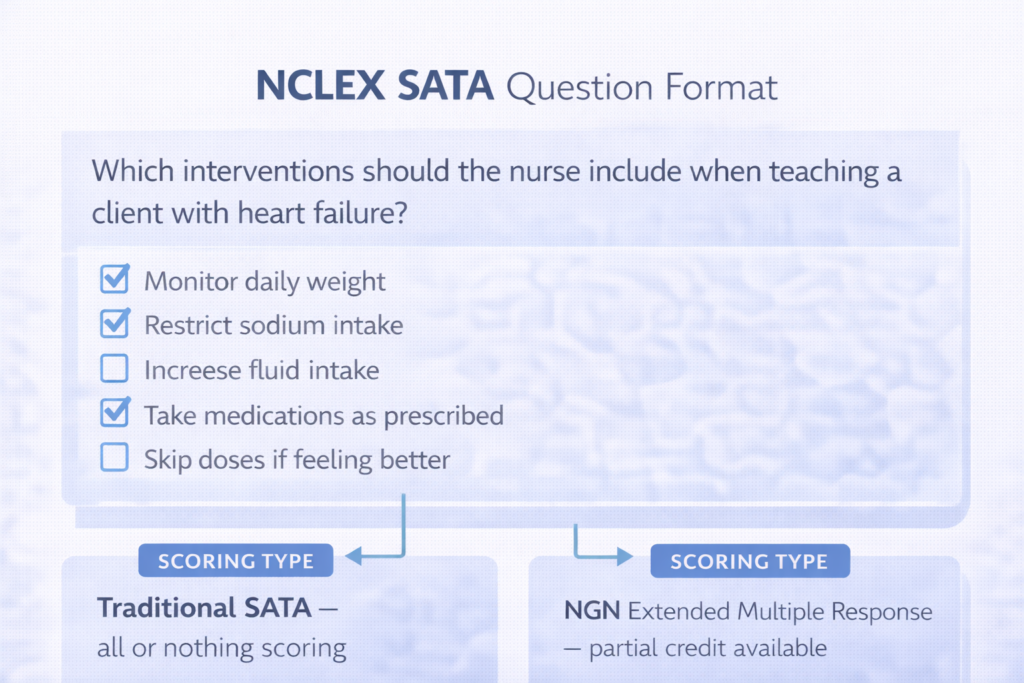
NCLEX SATA questions are multiple-response items that present a clinical scenario followed by a list of typically four to six options, any number of which may be correct. The correct number of responses is not disclosed — it could be two, three, four, or in some cases all of the listed options. Your task is to select every option that is clinically accurate and appropriate for the scenario, and to leave unselected every option that is not.
SATA questions are included on the NCLEX because they more accurately reflect real clinical nursing practice than single-answer multiple-choice items. In actual clinical settings, nursing decisions rarely involve choosing one correct action from a list of competing alternatives. More often, safe nursing care requires performing multiple concurrent assessments, implementing several interventions simultaneously, or teaching patients across multiple dimensions of a health condition. NCLEX SATA questions test your ability to recognize this clinical complexity — to know not just what the priority action is but to identify the full set of clinically indicated responses.
Under the Next Generation NCLEX, SATA questions have evolved into the extended multiple response format, which operates on the same core principle but may include a greater number of options and may assign partial credit based on the number of correct selections. Understanding both the traditional SATA format and the NGN extended multiple response format is essential for comprehensive NCLEX SATA questions preparation in 2026.
How SATA Questions Are Scored on the NCLEX
On traditional NCLEX SATA questions, scoring is all-or-nothing for each individual item: you must select all correct options and no incorrect options to receive credit for that question. There is no partial credit — selecting three of four correct options earns zero points for that item. This is why the evaluation strategy you apply to each individual option is so critical. Under the NGN extended multiple response format, partial credit is available based on the number of correct options selected and incorrect options avoided, which makes the independent evaluation of each option even more important.
The Core Strategy for NCLEX SATA Questions: Evaluate Each Option Independently
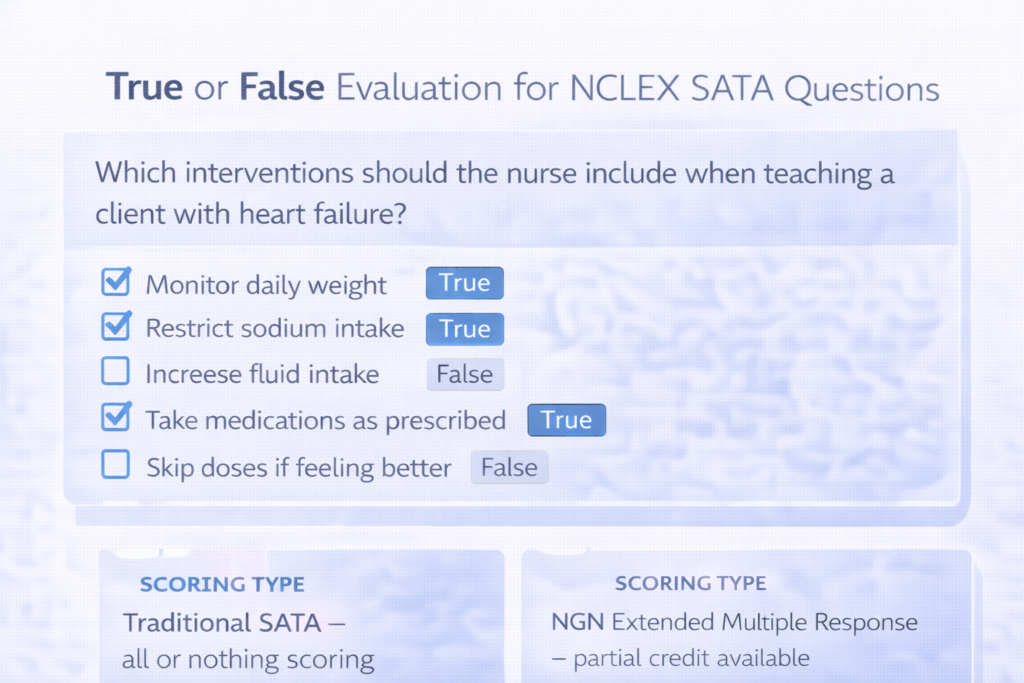
The single most important principle for NCLEX SATA questions is this: evaluate every option as an independent true or false statement. Do not look for a pattern, do not try to balance the number of options you select, and do not let your evaluation of one option influence your evaluation of another. Each option either is or is not clinically accurate and appropriate for the scenario presented — and your job is to make that determination for each one individually.
This principle sounds simple, but it runs directly counter to the habits most students have developed from years of multiple-choice testing. The instinct to find the best answer, to compare options against each other, or to select a set that feels balanced has no place in NCLEX SATA questions. An option is either correct or it is not, and that determination must be made on clinical grounds alone, independently for each item.
The True or False Test
A practical application of the independent evaluation principle is the true or false test. For each option in a NCLEX SATA question, cover the other options and ask yourself: given this clinical scenario, is this statement clinically true and is this action clinically indicated? If yes, select it. If no, do not select it. Do not ask whether this option is better than another option, whether this option seems like the type of answer that would be included, or whether you have already selected too many or too few options. The only question is whether this specific option is clinically accurate for this specific scenario.
Never Select an Option Based on Frequency
One of the most damaging habits on NCLEX SATA questions is selecting or deselecting options based on how many you have already chosen. Students who tell themselves ‘I have already selected three options, I should probably not select a fourth’ or ‘I have only selected one option, I must have missed something’ are allowing a completely irrelevant factor to override their clinical reasoning. The correct number of selections on a SATA question is whatever number of options are clinically true for the scenario — it could be one, it could be five. Let the clinical evaluation determine the count, never the other way around.
What to Look For in Each SATA Option: A Clinical Evaluation Checklist
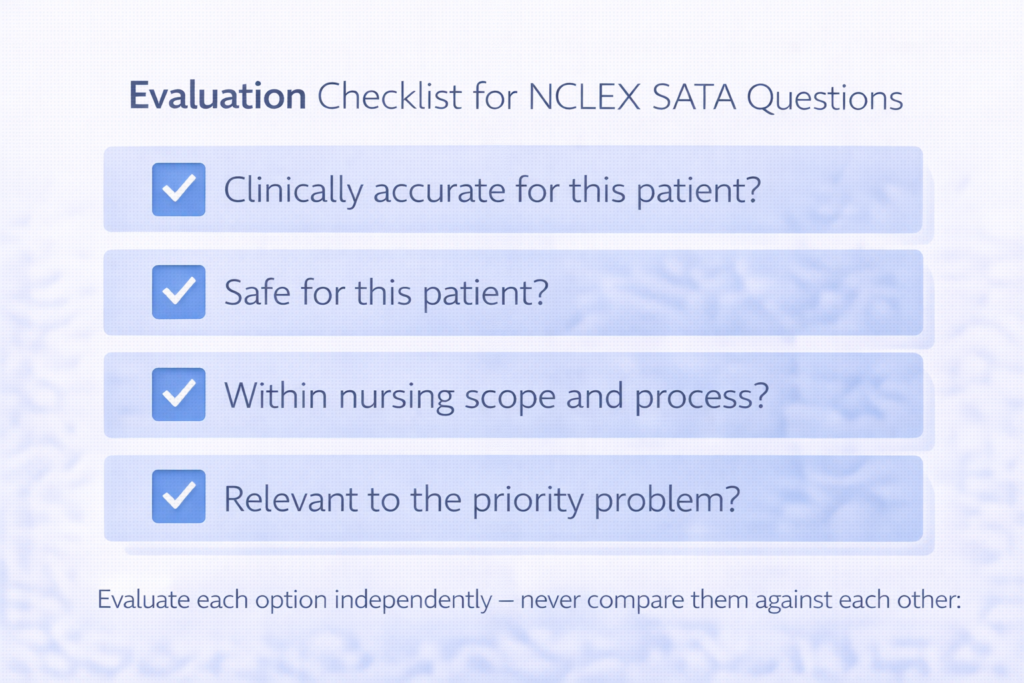
Applying the true or false test to each NCLEX SATA questions option requires a clear set of clinical criteria. The following checklist gives you a structured basis for evaluating each option independently and confidently.
Is This Option Clinically Accurate for This Patient?
The first evaluation criterion for every NCLEX SATA questions option is clinical accuracy within the context of the specific patient scenario. An option may be generally true in nursing practice but inaccurate for this particular patient — for example, recommending increased fluid intake is generally appropriate for many conditions but is contraindicated for a patient with fluid overload secondary to heart failure. Always evaluate accuracy against the specific clinical context, not against general nursing principles in the abstract.
Is This Option Safe for This Patient Right Now?
Safety is a non-negotiable evaluation criterion on NCLEX SATA questions. Any option that could harm the patient, that bypasses a physician order without clinical justification, or that implements an intervention before the appropriate assessment has been completed fails the safety test and should not be selected. The NCLEX is fundamentally a safety examination, and SATA questions consistently include unsafe options as distractors precisely because they test your ability to recognize clinical boundaries.
Is This Option Within Nursing Scope and the Nursing Process?
Each option in a NCLEX SATA question should be evaluated for scope of practice and alignment with the nursing process. Options that require a physician order that is not established in the scenario, that delegate tasks outside UAP or LPN scope, or that implement a plan before assessment and diagnosis are typically incorrect. The nursing process — assess, diagnose, plan, implement, evaluate — provides a reliable sequencing framework: options that skip steps in this sequence are frequently SATA distractors.
Is This Option Relevant to the Priority Problem in the Scenario?
NCLEX SATA questions frequently include options that are clinically accurate in general nursing practice but are not relevant to the specific clinical priority presented in the scenario. An option about patient teaching for a long-term lifestyle modification may be clinically accurate but completely irrelevant when the patient is in acute distress and the scenario is testing your recognition of immediate nursing priorities. Relevance to the current clinical situation — not general clinical truth — determines whether an option belongs in your selection.
Common Distractor Types in NCLEX SATA Questions
Understanding how NCLEX SATA questions are constructed — and specifically what types of distractors are used — gives you a significant advantage in the evaluation process. SATA distractors follow predictable patterns, and recognizing those patterns makes independent option evaluation faster and more reliable.
- The almost-correct distractor: This option contains a core clinical truth but includes one inaccurate or inappropriate element. For example, ‘Administer oxygen via non-rebreather mask at 2L/min’ — the intervention is correct but the flow rate for a non-rebreather mask is 10 to 15L/min, not 2L/min. Reading every option in its entirety, including specific clinical details like dosages, flow rates, and assessment parameters, is essential for catching this distractor type.
- The generally true but context-inappropriate distractor: This option is clinically accurate in general practice but is not appropriate for the specific patient and situation in the scenario. Instructing a patient to increase fluid intake is generally sound advice but is not appropriate for a patient with acute kidney injury and oliguria. Always evaluate against the specific scenario, not against general clinical principles.
- The future-appropriate but currently premature distractor: This option describes a nursing action that will be appropriate later in the care sequence but is not indicated as an immediate response. Providing discharge teaching to a patient who is in active respiratory distress is an example — the teaching will be necessary but the acute physiological concern takes precedence. These distractors test your understanding of clinical sequencing and priority.
- The outside-scope distractor: This option involves a nursing action that requires a physician order not established in the scenario, a procedure outside nursing scope, or a delegation to a team member inappropriate for the task. Recognizing scope-of-practice boundaries is a consistent component of NCLEX SATA questions across all content areas.
NCLEX SATA Questions vs. NGN Extended Multiple Response
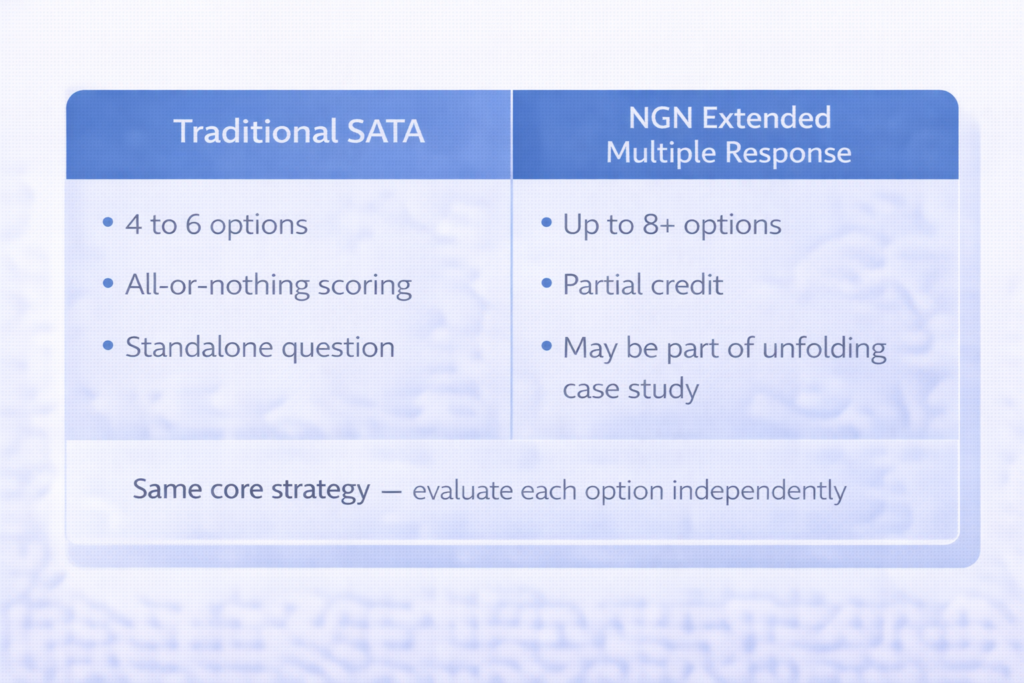
Under the Next Generation NCLEX, the extended multiple response format has evolved from traditional SATA questions in several important ways. Understanding the differences ensures your NCLEX SATA questions preparation covers both formats effectively.
Traditional SATA questions typically present four to six options and use all-or-nothing scoring. NGN extended multiple response items may present a larger number of options — sometimes eight or more — and use partial credit scoring based on the number of correct options selected and incorrect options avoided. The evaluation strategy remains identical: evaluate each option independently using the true or false test. But the partial credit structure of NGN items means that even incomplete correct selection earns some credit, making thorough option-by-option evaluation even more important than on traditional SATA items.
NGN extended multiple response items are also frequently embedded within unfolding case studies, where the clinical context has been established across multiple preceding questions. In these cases, apply the same independent evaluation strategy while drawing on the full clinical picture built up across the case — the patient’s established diagnosis, the clinical trajectory revealed in earlier questions, and the specific moment in the nursing process the current question is assessing.
How to Practice for Both Formats
When building your NCLEX SATA questions preparation, practice both traditional SATA items and NGN extended multiple response formats regularly. Use resources that provide both formats and that offer detailed rationales explaining why each individual option is correct or incorrect — not just why the overall answer set is correct. The option-level rationale is what builds the independent evaluation skill that both formats require.
How to Build NCLEX SATA Questions Mastery During Preparation
SATA mastery is built through deliberate, reflective practice — not simply through exposure to a high volume of SATA items. The following preparation strategies produce genuine improvement in SATA performance rather than the false familiarity that comes from repetitive practice without deep analysis.
- Dedicate specific practice sessions to SATA only: At least once per week, complete a focused NCLEX SATA questions practice session using a question bank filter to select only SATA items. This concentrated exposure builds the independent evaluation habit more quickly than SATA questions encountered randomly within mixed-format sessions.
- Write out your reasoning for each option: For the first two weeks of SATA practice, write a one-sentence clinical justification for every option you select and every option you reject. This forces explicit articulation of your clinical reasoning rather than relying on instinct. Over time, this process internalizes the independent evaluation habit so thoroughly that it becomes automatic during the exam.
- Review every option’s rationale after each session: Most question bank rationales for NCLEX SATA questions provide an explanation for each individual option — not just for the overall answer. Read every option-level rationale after each SATA session, including the options you evaluated correctly. Understanding why a distractor is wrong reinforces the clinical principle that makes the correct options right.
- Track your SATA-specific performance separately: Many practice platforms allow you to filter performance data by question type. Track your SATA accuracy separately from your overall accuracy to identify whether SATA is a specific area of weakness requiring targeted attention. If your SATA accuracy is significantly lower than your overall accuracy, the bottleneck is almost always the evaluation strategy — specifically, the habit of comparing options rather than evaluating them independently.

Conclusion
NCLEX SATA questions become significantly less intimidating — and significantly more accurate — once you replace the multiple-choice mindset with the independent evaluation approach the format demands. Evaluate every option as a true or false statement using the clinical checklist: is it accurate for this patient, is it safe, is it within nursing scope and process, and is it relevant to the current clinical priority? Select every option that passes all four criteria. Reject every option that fails any one of them. Never let the number of options you have already selected influence that evaluation.
Build this strategy into your preparation through dedicated SATA practice sessions, written option-level reasoning, thorough rationale review, and separate performance tracking. Apply the same strategy to NGN extended multiple response items, where partial credit makes thorough independent evaluation even more valuable. With consistent, deliberate practice, NCLEX SATA questions transform from your most feared format into one of the clearest demonstrations of your clinical judgment on exam day.
What is the best strategy for NCLEX SATA questions?
The best strategy for NCLEX SATA questions is to evaluate each option independently as a true or false clinical statement. For each option, ask: is this clinically accurate for this specific patient, is it safe, is it within nursing scope and the nursing process, and is it relevant to the current clinical priority? Select every option that satisfies all four criteria and reject every option that fails any one of them. Never compare options against each other or let the number of selections you have already made influence your evaluation of remaining options.
How many options are usually correct on NCLEX SATA questions?
The number of correct options on NCLEX SATA questions varies and is intentionally not disclosed in the question. It can range from one to all of the listed options. This is why you must evaluate each option independently rather than trying to identify a target number of selections. Let the clinical evaluation determine how many options you select — never the other way around.
Is there partial credit on NCLEX SATA questions?
Traditional NCLEX SATA questions use all-or-nothing scoring: you must select all correct options and no incorrect options to receive credit for that item. The NGN extended multiple response format, which evolved from traditional SATA, does award partial credit based on the number of correct options selected and incorrect options avoided. The independent evaluation strategy applies equally to both formats.
Why do I keep missing NCLEX SATA questions even when I know the content?
The most common reason for missing NCLEX SATA questions despite solid content knowledge is applying a multiple-choice evaluation strategy — looking for the best answer or comparing options against each other — rather than evaluating each option independently. Other common causes include selecting options based on how many you have already chosen, missing almost-correct distractors by not reading options in full clinical detail, and including generally true options that are not relevant to the specific patient scenario.
How are NGN extended multiple response questions different from traditional SATA?
NGN extended multiple response questions may offer more options than traditional NCLEX SATA questions, use partial credit scoring rather than all-or-nothing, and are frequently embedded within unfolding case studies where clinical context has been established across multiple preceding questions. The core evaluation strategy — evaluate each option independently as a true or false clinical statement — is identical for both formats. The partial credit structure of NGN items makes thorough independent evaluation of every option even more important.
Leave a Reply