
Understanding NCLEX question types before you begin your preparation is one of the most practical advantages you can give yourself. Many nursing students invest weeks building content knowledge without ever learning what the actual exam questions look like — and then encounter unfamiliar formats on exam day that cost them time, confidence, and correct answers.
The Next Generation NCLEX introduced a significant expansion of question formats in 2023, moving well beyond the traditional four-option multiple-choice item that candidates had prepared for in previous years. Today’s exam includes a mix of traditional and new NCLEX question types designed to assess clinical judgment across all six cognitive skills of the NCSBN Clinical Judgment Measurement Model — from recognizing clinical cues to evaluating patient outcomes.
This guide covers every NCLEX question type you will encounter on the 2026 exam. For each format, you will learn what it looks like, what clinical reasoning skill it tests, how to approach it strategically, and how to practice it effectively during your preparation. Knowing exactly what to expect from every question type eliminates the element of surprise and allows you to walk into the testing center with a practiced strategy for every format the exam can present.
Overview of NCLEX Question Types in 2026
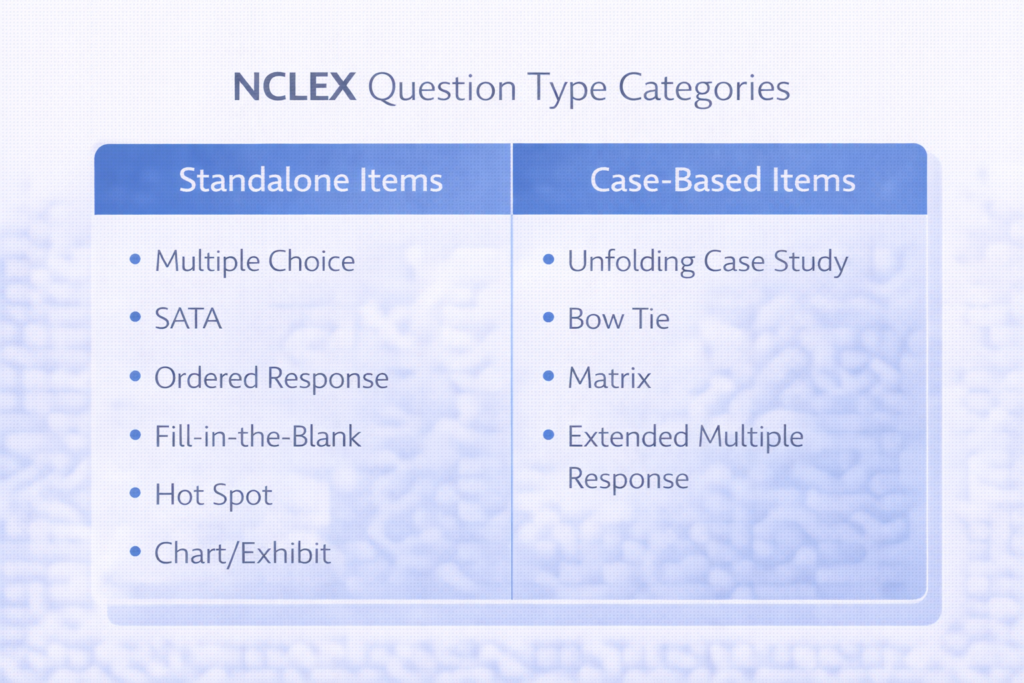
The NCLEX-RN uses a mixture of traditional and Next Generation question formats across every administration. Traditional NCLEX question types have been part of the exam for many years and remain a significant portion of every test. NGN formats were introduced with the April 2023 launch of the Next Generation NCLEX and assess the clinical judgment skills that the traditional formats could not fully capture.
All NCLEX question types share a common purpose: they assess your ability to think and act like a safe, entry-level registered nurse. Whether the format is a single multiple-choice item or a six-question unfolding case study, the underlying question is always the same — does this candidate have the clinical judgment to keep patients safe? Understanding this shared purpose across all NCLEX question types helps you approach every format as a clinical reasoning exercise rather than a test-taking puzzle.
The NCSBN does not publish the exact proportion of each question type on any given exam, as this varies by individual administration. What is consistent is that every candidate will encounter both traditional and NGN question types, and that preparation limited to only one category of NCLEX question types leaves a meaningful portion of the exam unprepared for.
The Two Categories of NCLEX Question Types
NCLEX question types fall into two broad categories. Standalone items are individual questions that present a complete clinical scenario and require a response that is independent of any other question. These include traditional multiple choice, SATA, ordered response, fill-in-the-blank, hot spot, and chart or exhibit items. Case-based items are clusters of questions tied to a shared evolving patient scenario — the unfolding case study is the primary example. Both categories include both traditional and NGN formats, and both require the same foundational clinical reasoning skills applied through different mechanical interfaces.
Traditional NCLEX Question Types You Must Know
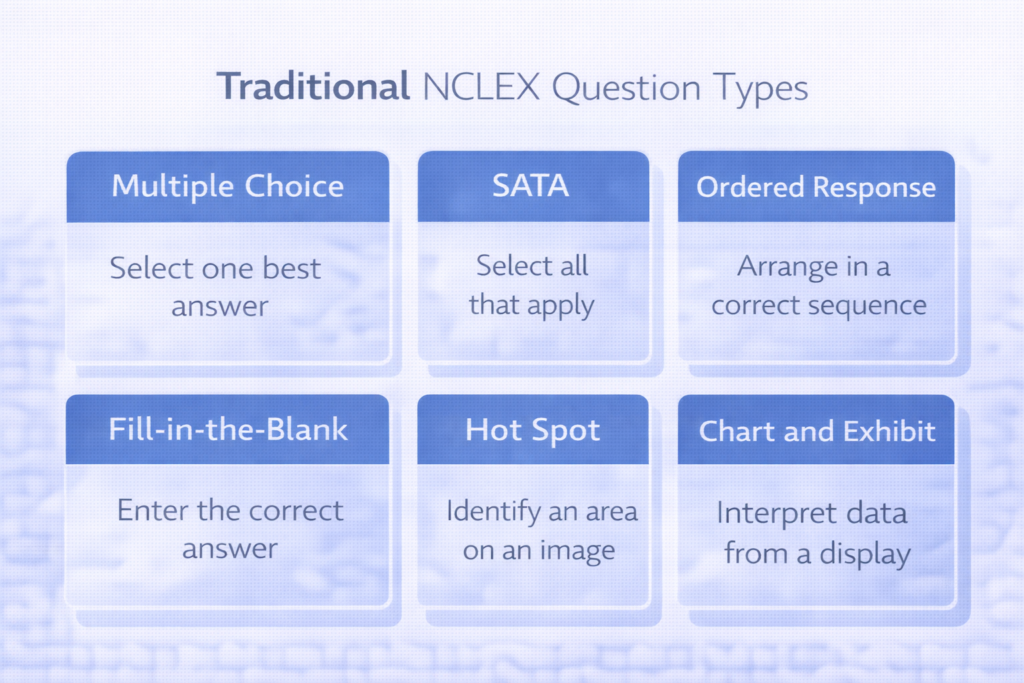
Multiple Choice — The Foundation
Traditional multiple choice is the most familiar of all NCLEX question types and remains the most common format on the exam. Each item presents a clinical scenario followed by four answer choices, exactly one of which is correct. The three incorrect options are called distractors and are constructed to be plausible — they represent real nursing actions or clinical facts, but each contains a specific clinical flaw that makes it wrong for this particular scenario. The strategy for traditional multiple choice is systematic elimination: read the stem completely, identify what is being asked, and work through the answer choices using clinical reasoning frameworks — the ABCs, Maslow’s hierarchy, the nursing process — to identify and eliminate the distractors until the correct answer is clear.
Select All That Apply — SATA
SATA questions are among the most challenging of the traditional NCLEX question types for most candidates. Each item presents a clinical scenario followed by a list of four to six options, any number of which may be correct. Traditional SATA items use all-or-nothing scoring — you must select every correct option and no incorrect options to receive credit. The core strategy is to evaluate each option independently as a true or false clinical statement for the specific scenario presented. Never compare options against each other, never select based on how many you have already chosen, and never treat these NCLEX question types like a multiple-choice item in disguise. Each option either is or is not clinically accurate and appropriate for this patient right now.
Ordered Response
Ordered response questions present a list of nursing actions, assessment steps, or clinical events and ask you to arrange them in the correct sequence. These NCLEX question types most commonly test the nursing process — assessment before diagnosis, diagnosis before planning, planning before implementation — or the correct sequence of a specific clinical procedure. The strategy is to identify the first action using the ABCs and nursing process, then work forward sequentially from there. A common error on ordered response items is beginning with a clinically appropriate but premature step — for example, placing intervention before assessment because the intervention feels more urgent. Correct sequencing always respects the clinical logic of the scenario, not the emotional urgency of the choices.
Fill-in-the-Blank Calculation
Fill-in-the-blank calculation questions require you to perform a medication dosage or IV flow rate calculation and enter the numerical answer directly. These NCLEX question types test mathematical accuracy and clinical safety in medication administration. The strategy is straightforward: identify the given values, set up the calculation using dimensional analysis or the desired-over-have method, perform the arithmetic carefully, and double-check your answer before entering it. Pay close attention to units — converting between milligrams and micrograms, or between milliliters per hour and drops per minute, is a common source of calculation errors on these items.
Hot Spot
Hot spot questions present a graphic — most commonly an anatomical diagram, an ECG strip, an image of a medication label, or an IV insertion site — and ask you to identify a specific location or finding by clicking on the correct area of the image. These NCLEX question types test visual clinical knowledge, such as correctly identifying a dysrhythmia on a rhythm strip, locating the correct site for an injection, or identifying an abnormal finding on a wound image. Practice with these items requires working with visual clinical resources during your preparation — ECG interpretation resources, anatomical diagrams, and medication label review are the most high-yield visual content areas for hot spot items.
Chart and Exhibit
Chart and exhibit questions present a simulated patient chart or clinical document — such as a medication administration record, a laboratory results page, an intake and output record, or a set of nursing notes — and ask you to answer a clinical question based on the information in the document. These NCLEX question types test your ability to extract and interpret relevant clinical data from a realistic documentation format, which mirrors the EHR navigation skills the NGN unfolding case study format assesses in greater depth. The strategy is to read the question stem first, then navigate the exhibit to find only the information relevant to what is being asked — do not try to process the entire document before understanding what the question needs.
NGN NCLEX Question Types Introduced With the Next Generation Exam
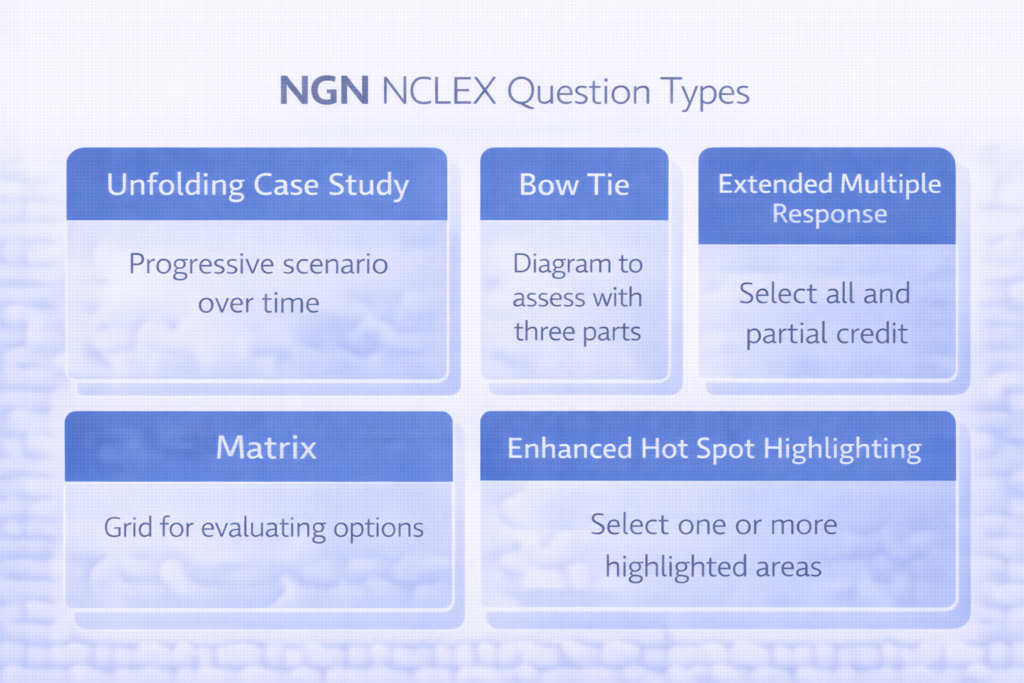
The Next Generation NCLEX introduced a new set of NCLEX question types specifically designed to assess clinical judgment across all six cognitive skills of the Clinical Judgment Measurement Model. These formats require more complex reasoning than traditional items and present clinical scenarios with greater depth and evolution. Understanding each NGN question type and how to approach it is essential preparation for the 2026 exam.
Unfolding Case Study
The unfolding case study is the most complex and most clinically representative of all NCLEX question types. Each case presents an evolving patient scenario across six questions, with new clinical information revealed between each question. The six questions map to the six CJMM cognitive skills in order: Recognize Cues, Analyze Cues, Prioritize Hypotheses, Generate Solutions, Take Actions, and Evaluate Outcomes. The strategy for unfolding case studies is to read the entire available scenario before answering the first question, then update your clinical picture as each new piece of information is revealed. Do not treat the six questions as independent items — they form a continuous clinical narrative, and information from earlier questions is relevant to and sometimes required for later ones. Complete all six questions before reviewing rationales to preserve the integrity of the evolving scenario.
Bow Tie
Bow tie questions present a clinical scenario and a visual bow tie diagram with three sections: the condition or problem most likely present in the center, the nursing actions to take on the left, and the parameters to monitor on the right. These NCLEX question types test integrated clinical judgment across three simultaneous reasoning dimensions. The strategy is to anchor on the center first — identify the condition most likely present based on all available clinical data, then populate the left and right wings based on that central hypothesis. Candidates who try to evaluate all three sections simultaneously without first establishing the central condition consistently struggle with this format. Fix the center, then reason outward.
Extended Multiple Response
Extended multiple response is the NGN evolution of traditional SATA and is one of the NCLEX question types that now appears both as standalone items and embedded within unfolding case studies. Unlike traditional SATA, extended multiple response items may offer a larger number of options and award partial credit based on the number of correct options selected and incorrect options avoided. The evaluation strategy is identical to SATA: evaluate each option independently as a true or false clinical statement for the specific scenario. The partial credit structure makes thorough evaluation of every option — including the ones you are most uncertain about — even more important than on all-or-nothing traditional SATA items.
Matrix Questions
Matrix questions present a clinical scenario and a grid format in which rows represent clinical findings, patient characteristics, or nursing actions, and columns represent categories such as ‘indicated,’ ‘contraindicated,’ ‘effective,’ or ‘ineffective.’ These NCLEX question types require you to make a clinical determination for each row across the matrix, evaluating each cell independently. The strategy is to treat each row as a separate clinical question, applying the same true or false evaluation logic used in SATA and extended multiple response. Matrix items frequently appear within unfolding case studies and test the Evaluate Outcomes cognitive skill — asking you to assess whether a set of interventions or findings indicates that a care plan is working as expected.
Enhanced Hot Spot — Highlighting
Enhanced hot spot questions in the NGN format present a text passage — such as a section of nursing notes, a physician’s history and physical, or a set of assessment findings — and ask you to highlight the specific words or phrases that represent relevant clinical findings for the question being asked. These NCLEX question types test the Recognize Cues cognitive skill — your ability to identify clinically significant information within a larger body of text. The strategy is to read the question stem first to understand exactly what type of cue you are looking for, then scan the passage deliberately for findings that meet that specific clinical criterion. Highlighting too broadly — selecting irrelevant findings alongside relevant ones — is the most common error on this format.
How to Build a Practice Plan Around All NCLEX Question Types
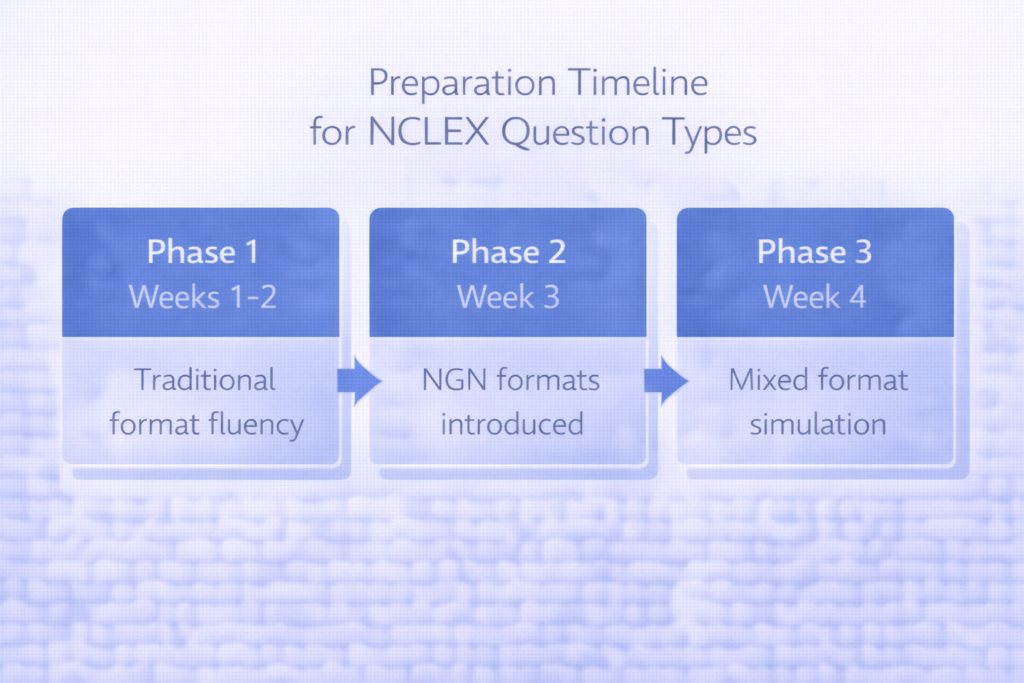
Knowing all NCLEX question types is only useful if your preparation systematically covers each one with enough depth and repetition to produce genuine fluency. The following framework integrates all question types into a structured preparation approach.
Weeks 1 to 2: Establish Traditional Format Fluency
In the first two weeks of preparation, focus your NCLEX question types practice on traditional formats — multiple choice, SATA, ordered response, fill-in-the-blank, and hot spot. These formats form the majority of most practice question banks and provide the clinical reasoning foundation that NGN formats build on. Complete daily practice blocks of 50 to 75 questions in mixed traditional formats, review every rationale in full, and track your performance by content area. By the end of week two, traditional NCLEX question types should feel familiar and your clinical reasoning frameworks should be actively in use.
Week 3: Introduce NGN Formats Deliberately
Beginning in week three, introduce NGN NCLEX question types into your daily practice. Start with extended multiple response and matrix items, which share the independent evaluation logic of SATA and are accessible entry points to NGN reasoning. Add bow tie questions mid-week, using the center-first anchoring strategy. By the end of week three, begin working through complete unfolding case studies as timed, uninterrupted six-question sessions. Use the free NGN sample questions on the NCSBN website as your reference standard for what authentic NGN items look like.
Week 4: Mixed Format Simulation
In the final preparation week, practice exclusively with mixed-format question sets that replicate the variety of NCLEX question types you will encounter on exam day. Full-length simulated exams that include both traditional and NGN formats are the most direct preparation for the actual test experience. The goal is not to encounter new question types in week four — it is to confirm that every format feels practiced, familiar, and approachable under timed exam conditions.
Common Mistakes When Preparing for Different NCLEX Question Types
Even well-prepared candidates make predictable mistakes when it comes to NCLEX question types. Awareness of these errors helps you avoid them during your preparation and on exam day.
- Preparing only for traditional multiple choice: The most common preparation gap is spending the entirety of preparation time on traditional four-option multiple-choice questions and encountering NGN formats for the first time on exam day. Every NCLEX question type requires its own preparation strategy, and NGN formats in particular require dedicated practice to build the format-specific reasoning skills they demand.
- Treating NGN formats as variations of multiple choice: Candidates who approach bow tie questions, unfolding case studies, and matrix items using multiple-choice reasoning — looking for the single best answer or comparing options against each other — consistently underperform on these formats. Each NGN question type has its own evaluation logic, and applying the wrong logic produces avoidable errors regardless of content knowledge.
- Skipping calculation practice: Fill-in-the-blank calculation items require mathematical accuracy that does not improve with clinical reasoning practice alone. Dedicated medication calculation practice — including dimensional analysis, IV flow rate calculations, and weight-based dosing — must be a regular component of preparation for these NCLEX question types.
- Under-practicing visual question types: Hot spot and enhanced highlighting items require visual clinical recognition skills that text-based preparation does not build. Integrate ECG strip interpretation, anatomical identification, and clinical document analysis into your preparation specifically to develop the visual reasoning these NCLEX question types assess.
Rushing through unfolding case studies: Unfolding case studies reward candidates who read the evolving scenario carefully and update their clinical picture with each new piece of information. Rushing through the scenario to reach the questions faster produces the same result as misreading a patient’s clinical trajectory in practice — errors that compound across subsequent questions because the foundational clinical picture is incomplete.

Conclusion
Every NCLEX question type on the 2026 exam — from traditional multiple choice and SATA to NGN unfolding case studies, bow tie questions, matrix items, and enhanced highlighting — tests the same foundational skill: clinical judgment. The formats differ in their mechanics and the specific cognitive skills they emphasize, but the underlying standard is constant. A safe, competent nurse recognizes clinical cues, reasons through their significance, prioritizes a response, generates and implements appropriate care, and evaluates outcomes.
Build familiarity with every NCLEX question type into your preparation from the start. Practice traditional formats first to establish your clinical reasoning foundation, then systematically introduce NGN formats with format-specific strategies. By week four, every question type should feel practiced and approachable. Walk into the testing center knowing that there is no format the NCLEX can present that you have not prepared for — that preparation is what transforms uncertainty into confidence on exam day.
What are the different types of NCLEX questions?
NCLEX question types fall into two categories: traditional standalone items and NGN case-based items. Traditional formats include multiple choice, select all that apply, ordered response, fill-in-the-blank calculation, hot spot, and chart or exhibit questions. NGN formats include unfolding case studies, bow tie questions, extended multiple response, matrix questions, and enhanced hot spot highlighting. Every candidate will encounter both traditional and NGN formats on their exam.
What is the hardest NCLEX question type?
Most candidates find SATA and unfolding case studies to be the most challenging NCLEX question types. SATA requires independent evaluation of every option without the single-answer structure most students are accustomed to. Unfolding case studies require sustained clinical reasoning across six evolving questions, drawing on all six CJMM cognitive skills in sequence. Both formats become significantly more manageable with format-specific preparation strategies and deliberate practice.
How many NGN questions are on the NCLEX?
The NCSBN does not publish the exact proportion of NGN versus traditional NCLEX question types for any given administration, as this varies. What is confirmed is that every candidate will encounter NGN formats including unfolding case studies and other new item types. Treating NGN preparation as optional or secondary is one of the most significant preparation gaps a candidate can have going into the 2026 exam.
Do all NCLEX question types count the same toward your score?
Traditional NCLEX question types that use all-or-nothing scoring — including standard multiple choice and traditional SATA — each count as a single item. NGN extended multiple response and matrix items that use partial credit scoring award points based on the number of correct selections made and incorrect options avoided. Unfolding case study sets of six questions each count as six individual scored items. The adaptive algorithm uses all responses to determine competence level.
How should I practice for NGN NCLEX question types?
Start NGN practice in week three of a four-week preparation plan, after establishing fluency with traditional NCLEX question types. Begin with extended multiple response and matrix items, then add bow tie questions using the center-first strategy, then progress to complete unfolding case study sets. Use the free NGN sample questions on the NCSBN website as your primary reference for authentic NGN format practice. Work through unfolding case studies as uninterrupted six-question sessions before reviewing rationales.
Leave a Reply