
NCLEX question practice is the most powerful preparation tool available to nursing students — but only when it is done correctly. The majority of candidates who work through thousands of practice questions and still feel underprepared are not failing because they did too few questions. They are failing because they are using practice questions as a performance test rather than a learning engine. The way you practice matters far more than how much you practice.
The Next Generation NCLEX tests clinical judgment — the ability to recognize clinical cues, analyze their significance, prioritize a response, generate and implement solutions, and evaluate outcomes across evolving patient scenarios. Building that level of reasoning requires a specific kind of NCLEX question practice: deliberate, reflective, and anchored in deep rationale analysis rather than rapid question completion.
This guide walks through the complete method for effective NCLEX question practice in 2026. It covers how to structure your practice sessions, how to use rationale review for maximum learning, how to track your performance data strategically, how to integrate NGN formats into your daily practice, and how to build the daily habits that turn question practice into genuine exam readiness.
Why Most NCLEX Question Practice Does Not Work
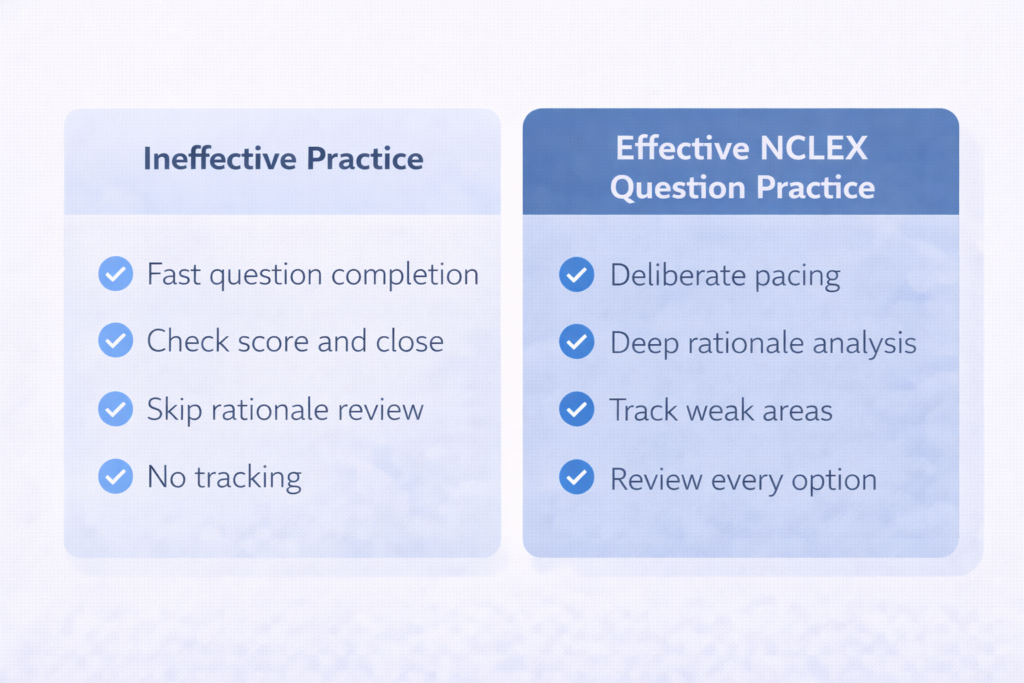
The most common approach to NCLEX question practice looks like this: open a question bank, work through 50 to 100 questions as quickly as possible, check the final score, feel good or bad depending on the percentage, and close the platform. This approach is almost entirely ineffective for building clinical reasoning — and it is what the majority of nursing students do.
The problem is not the questions. High-quality NCLEX question banks are built to mirror the clinical reasoning demands of the actual exam. The problem is the practice method. Rapid-fire question completion trains speed and pattern recognition at a surface level, but it does not build the deep reasoning pathways the NCLEX tests. The adaptive exam is specifically designed to push beyond surface-level pattern recognition into genuine clinical judgment — and no amount of rapid practice prepares you for that if the underlying reasoning is never developed.
Effective NCLEX question practice requires slowing down and going deeper. It requires treating every rationale as a clinical lesson, every incorrect answer as a diagnostic signal, and every question as an opportunity to build a reasoning pattern rather than simply produce a correct answer. The candidates who improve most dramatically during NCLEX preparation are not those who do the most questions — they are those who extract the most learning from each question they complete.
The Practice-to-Review Ratio
A foundational principle of effective NCLEX question practice is maintaining at least a one-to-one ratio of practice time to review time. For every minute you spend answering questions, spend at least one minute reviewing rationales. For most candidates, the review phase should actually exceed the practice phase in duration — a 50-question session that takes 60 minutes to complete deserves 60 to 90 minutes of deliberate rationale analysis. This ratio feels counterintuitive because reviewing feels less productive than answering. But the review is where the clinical reasoning is built.
How to Structure an Effective NCLEX Question Practice Session
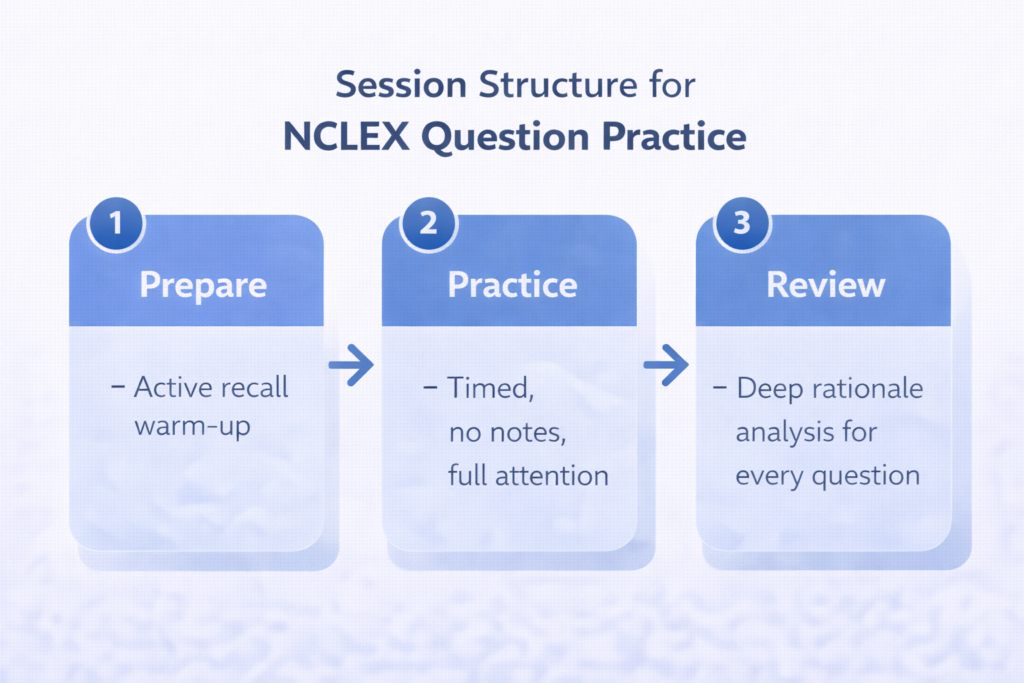
The structure of your NCLEX question practice session determines how much learning you extract from it. A well-structured session has three distinct phases: preparation, active practice, and rationale review. Each phase requires deliberate engagement to produce the clinical reasoning development that exam performance depends on.
Phase 1: Prepare Before You Begin
Before opening your question bank, spend three to five minutes activating the content area you are about to practice. If today’s NCLEX question practice session focuses on cardiovascular nursing, spend a few minutes doing a brief active recall warm-up — write down the key conditions, priority assessments, and high-yield medications you associate with cardiovascular nursing without looking at your notes. This retrieval warm-up activates the relevant knowledge in working memory before the questions arrive, which produces stronger encoding of any new clinical reasoning patterns you encounter during the session.
Phase 2: Practice With Full Attention
During the active practice phase of your NCLEX question practice session, work through your question block under timed conditions with no notes, no references, and no interruptions. Read each question stem completely before looking at the answer choices. Identify what is being asked. Evaluate the answer choices using systematic elimination. Commit to your answer. If you are uncertain, make your best clinical reasoning decision and move forward — do not leave questions unanswered and do not change answers out of anxiety rather than new clinical insight. The goal of the active practice phase is not a perfect score. It is an honest, unassisted demonstration of your current clinical reasoning.
Phase 3: Rationale Review — The Most Important Phase
The rationale review phase is where effective NCLEX question practice actually happens. After completing your question block, go through every question — not just the ones you answered incorrectly. For each question, read the full rationale and ask yourself three things: what clinical concept was being tested, what reasoning led to the correct answer, and why were each of the incorrect options wrong? For questions you answered correctly, confirm that your reasoning matches the rationale — correct answers reached by incorrect reasoning represent a vulnerability that will cost you on similar questions in the future. For questions you answered incorrectly, identify specifically where your reasoning diverged from clinical standard and write a brief note capturing the correct principle.
How to Review Rationales for Maximum Learning
Rationale review is the engine of effective NCLEX question practice, and the quality of that review determines how much your clinical reasoning improves between sessions. Most students read the correct answer explanation and move on. The most effective students go significantly deeper.
Analyze Every Answer Choice, Not Just the Correct One
For every NCLEX question practice item you review, analyze all four answer choices — not just the one that is correct. For each incorrect option, identify the specific clinical reason it is wrong: is it unsafe, does it skip assessment, does it address a lower priority, is it factually inaccurate, or does it represent an inappropriate delegation? Understanding the clinical flaw in each distractor builds your ability to recognize those flaws in future questions — including questions where the distractors are constructed differently but exploit the same reasoning vulnerability.
Write Down Reasoning Errors, Not Just Content Gaps
When you miss a question during NCLEX question practice, the instinctive response is to identify the content gap — ‘I need to study more about digoxin toxicity.’ Sometimes that is the right diagnosis. But more often, the error is a reasoning error rather than a content gap: you selected an intervention before assessment, you prioritized a chronic finding over an acute one, you confused two similar clinical presentations, or you chose the option that addressed a secondary concern when a primary concern was present. Writing down the reasoning error specifically — not just the topic — is what prevents the same error pattern from repeating across different content areas.
Build a Personal Rationale Notes Document
One of the highest-yield habits in NCLEX question practice is maintaining a personal rationale notes document — a running record of the clinical principles, reasoning patterns, and content corrections you collect during rationale review. Organize it by content area. After each practice session, add two to three new entries based on what you learned. Review the document weekly. Over four weeks of consistent NCLEX question practice, this document becomes a personalized, high-yield review resource built entirely from your own diagnostic data — a record of exactly the reasoning patterns you needed to build and have now reinforced.
How to Track Performance Data During NCLEX Question Practice
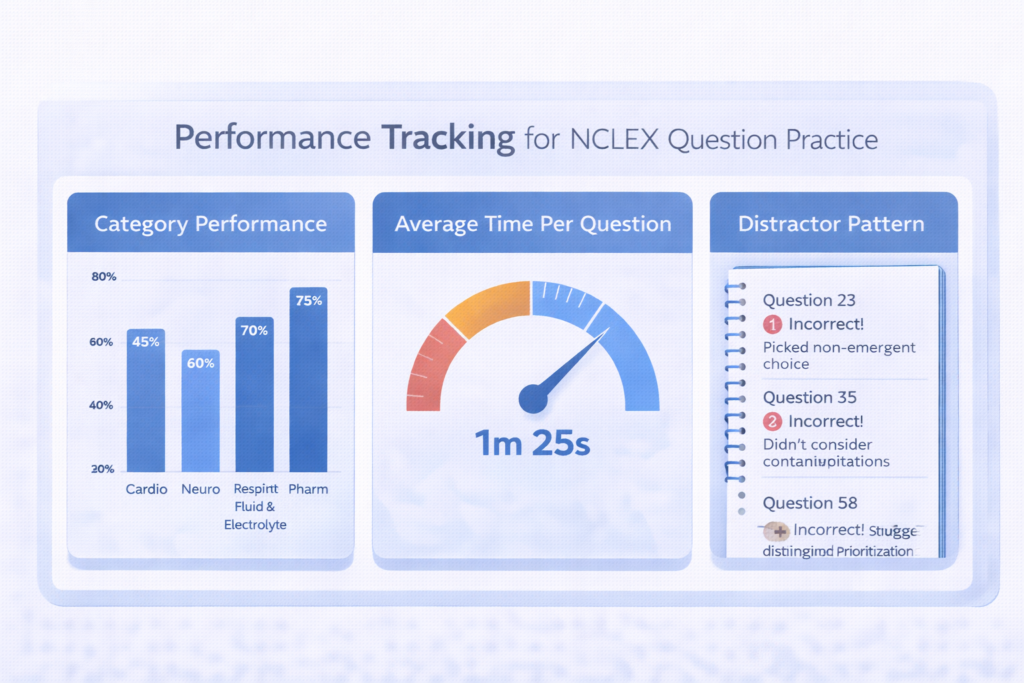
Performance tracking is the feedback mechanism that makes NCLEX question practice self-correcting. Without tracking, it is impossible to know whether your preparation is producing improvement in the right areas or whether you are spending study time efficiently. With tracking, your practice data becomes a precise diagnostic tool that directs your preparation toward the highest-leverage opportunities.
Track Performance by Content Category
Every reputable NCLEX question practice platform provides a performance breakdown by content category. Review this breakdown after every session and weekly in aggregate. You are looking for two things: content areas where your performance is consistently below your overall average — these are your priority review targets — and content areas where your performance has plateaued despite repeated practice, which typically signals that the bottleneck is a reasoning error pattern rather than a content gap. Both findings require different responses, and tracking makes them visible.
Track Time Per Question
Most platforms also record how long you spend on each question during NCLEX question practice. Review your average time per question regularly. If your average exceeds two minutes, identify whether the excess comes from difficult questions, from indecision between final two options, or from re-reading stems multiple times. If your average is below 60 seconds, you are almost certainly moving too fast and under-analyzing answer choices. Time tracking adds a pacing dimension to your performance data that content tracking alone cannot provide.
Track Your Distractor Selection Patterns
When you answer a question incorrectly during NCLEX question practice, note which distractor you selected and why it appealed to you. Over time, patterns emerge: you may consistently select intervention options before assessment options, or you may consistently choose the option that addresses the most visually prominent symptom rather than the underlying clinical priority. Identifying your personal distractor vulnerability patterns — the specific reasoning traps you fall into repeatedly — is one of the most direct paths to improvement available in NCLEX question practice.
Integrating NGN Formats Into Your NCLEX Question Practice
Effective NCLEX question practice in 2026 must include deliberate, regular practice with Next Generation NCLEX question formats. Candidates who practice exclusively with traditional multiple-choice questions are leaving a significant portion of the exam unprepared for, regardless of how strong their content knowledge is.
Start NGN Practice Early
Introduce NGN format questions into your NCLEX question practice from the first week of preparation — not the final week. The NGN formats, particularly unfolding case studies and bow tie questions, require a different cognitive approach than traditional multiple-choice. Unfolding case studies ask you to follow an evolving clinical narrative across six questions, applying a different CJMM cognitive skill at each step. Bow tie questions require you to simultaneously reason about conditions, actions, and monitoring parameters as an integrated clinical picture. Building fluency with these formats takes time and repetition — exposure in the final week produces familiarity but not competence.
Practice Unfolding Case Studies Without Stopping
When practicing NGN unfolding case studies during your NCLEX question practice sessions, work through all six questions in a single uninterrupted sitting before reviewing the rationales. Pausing mid-case to look up information or review earlier answers defeats the purpose of the format — the case study is designed to test how your clinical picture updates as new information arrives. The discipline of completing the full case before reviewing mirrors the actual exam experience and builds the cognitive stamina the format requires.
Use the NCSBN Sample Questions
The NCSBN provides free sample NGN questions on their website that represent the most authentic NGN NCLEX question practice available. These are the closest existing approximation to actual exam items and should be a standard part of your preparation. Work through every available sample question, use the accompanying rationales as your primary reference for NGN reasoning standards, and return to them periodically throughout your preparation to reinforce your NGN reasoning approach.
Daily NCLEX Question Practice Habits That Build Exam Readiness
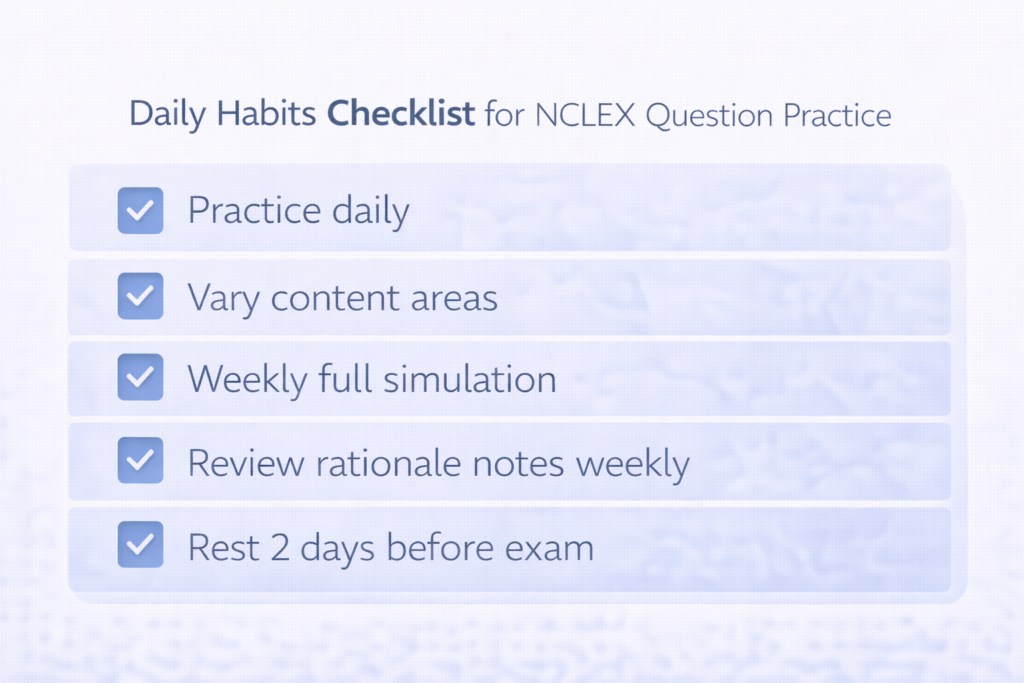
The cumulative effect of daily NCLEX question practice habits is what produces genuine exam readiness. Individual sessions matter, but consistency across weeks is what builds the reasoning depth and the clinical pattern recognition that holds up under the pressure of the adaptive exam.
- Practice every day without exception: Consistency in NCLEX question practice is more important than session length. A focused 45-minute session every day produces stronger, more durable reasoning development than a four-hour marathon session once a week. Daily practice maintains the active retrieval cycle that spaced repetition depends on and keeps your clinical reasoning patterns in regular use rather than letting them fade between infrequent sessions.
- Vary your question content daily: Rotating through different content areas in your daily NCLEX question practice prevents the false confidence that comes from repeatedly practicing only in your strongest areas. Build a weekly content rotation that covers cardiovascular, respiratory, neurological, pharmacology, mental health, maternal newborn, pediatrics, and safe care environment across the week, with extra sessions allocated to your weakest areas.
- Complete at least one full-length simulation per week: Once per week, complete a full-length 75 to 100 question simulated exam under strict timed conditions with no breaks or references. Full-length simulation builds the cognitive stamina that daily shorter practice blocks cannot replicate and provides a weekly benchmark of your overall NCLEX question practice progress.
- Review your rationale notes document every Sunday: Set aside time at the end of each week to review your running rationale notes document. Identify whether the reasoning errors from earlier in the week recurred later in the week. If they did, those patterns need targeted attention in the coming week’s practice. If they did not, they are becoming part of your reliable clinical reasoning repertoire.
- Stop practicing two days before your exam: The final two days before the NCLEX are not for NCLEX question practice. They are for consolidation, rest, and confidence-building. Your clinical reasoning is built. Additional practice at this stage produces anxiety more reliably than improvement. Trust the preparation you have done and protect your cognitive and emotional resources for exam day.
Common NCLEX Question Practice Mistakes and How to Fix Them
Even students who understand effective NCLEX question practice in theory fall into predictable mistakes that reduce the return on their preparation time. Recognizing these patterns early allows you to correct them before they become ingrained habits.
- Practicing with notes open: Doing NCLEX question practice with your review book or notes nearby — looking up answers mid-session — eliminates the productive struggle that drives learning. The difficulty of working without a safety net is the mechanism by which clinical reasoning is built. Remove all references before beginning each practice session.
- Only reviewing incorrect answers: Reviewing only the questions you answered incorrectly misses a critical category of learning: questions you answered correctly but for the wrong reason. Always review every rationale, including the correct answers, to confirm your reasoning aligns with clinical standard rather than lucky guessing.
- Using only one question bank: Exposure to a single question bank creates pattern familiarity rather than clinical reasoning fluency. Different well-constructed question banks approach the same clinical concepts from different angles, which builds more flexible and durable reasoning. Use at least two reputable resources across your preparation.
- Ignoring the performance data: Many students complete practice sessions, note their percentage score, and ignore the category breakdown and time data. This is one of the most common ways that NCLEX question practice fails to produce improvement — the performance data contains the precise diagnostic information needed to direct preparation efficiently, and ignoring it means studying blind.

Conclusion
Effective NCLEX question practice is not about completing the most questions — it is about extracting the most clinical reasoning development from every question you complete. Structuring your sessions with a preparation phase, deliberate active practice, and deep rationale review; tracking performance data by category, time, and distractor pattern; integrating NGN formats from the start; building consistent daily practice habits; and correcting the common mistakes that reduce return on practice time are what separate candidates who improve from those who plateau.
Start applying this method to your NCLEX question practice today. The clinical reasoning skills you need to pass the exam are not waiting to be memorized — they are waiting to be built, one well-reviewed question at a time. With consistent, deliberate practice and genuine engagement with every rationale, you give yourself the strongest possible foundation for exam day.
How should I practice NCLEX questions effectively?
Effective NCLEX question practice follows a three-phase structure: a brief active recall warm-up before the session, a timed active practice block with no references or notes, and a deep rationale review phase where you analyze every answer choice for every question — right or wrong. Maintain at least a one-to-one ratio of practice time to review time, and track your performance data by content category, time per question, and distractor selection patterns.
How many NCLEX practice questions should I do per day?
Most candidates benefit from 50 to 75 questions per day during the middle weeks of preparation, scaling up to 75 to 100 by the final weeks. More important than the number is the quality of your rationale review. A session of 50 questions with thorough rationale analysis produces far more clinical reasoning development than 150 questions with no review. Build daily consistency over daily volume.
Should I review all NCLEX practice questions or only the wrong ones?
Review every question — not just the ones you answered incorrectly. Questions you answered correctly but for the wrong reason represent reasoning vulnerabilities that will cost you on similar questions in the future. Confirming that your reasoning matches the clinical rationale, even on correct answers, is a critical quality check that most candidates skip and that the most effective NCLEX question practice never omits.
When should I start practicing NGN NCLEX questions?
From the very first week of preparation. NGN formats — unfolding case studies, bow tie questions, extended multiple response items — require a different cognitive approach than traditional multiple-choice questions, and building fluency with them takes time and repetition. Introducing NGN question practice early ensures that these formats feel practiced and familiar on exam day rather than novel and threatening.
How do I know if my NCLEX question practice is working?
Track your performance by content category across weekly practice sessions. You should see improvement in your weakest categories by the second and third weeks. If performance is plateauing despite consistent practice, the bottleneck is almost always in rationale review quality — you are answering questions but not deeply processing the reasoning behind each answer. Slow down the review phase, write down reasoning errors explicitly, and redirect study time toward the specific weak areas your data identifies.
Leave a Reply